

A corporate video script breaks the film down into parts and specifies, for each one, the picture, the on-screen text, the voice and the sound. Allow 120 to 150 words per minute of speech, write a voiceover word for word but only questions for an interview, and approve the text before the storyboard.
A corporate video is often decided before the shoot, on a few pages of text. The script sets what each person will say, what the camera will have to show and how long the film will run. This guide gives you the number of words for each length, the structure by format, a real annotated script, the one for the Accor D&TS film, and the column template Biux uses.
What is a video script?
A video script is a film’s reference text: it describes, part by part, what the viewer will see and hear, before a single image is shot or animated. In a company, its main use is to get the substance approved (the message, the facts, the people who speak) at a stage when a correction costs only one line.
Brief, script, storyboard: who does what
Three documents follow one another before a shoot. Each answers a different question, and confusing them forces you to backtrack.
| Document | Question it answers | Who writes it | Who approves it |
|---|---|---|---|
| Brief | Why this film, for whom, with what constraints? | The company, with the agency’s help | The person commissioning the film |
| Script | What do we see and hear, part by part? | The agency, based on the brief | The company, and its experts for the facts |
| Storyboard | Which shots, in what order, with what framing? | The agency, based on the approved script | The company, before the shoot or the animation |
The video brief sets the framework: goal, target audience, message, length, deliverables. The script is its written answer. The video storyboard comes next and translates this text into shots. This guide covers only the middle step: the other two documents each have their own article.
On the Accor D&TS film, the three documents followed one another like this: a brief from the communications department, with its constraints (three minutes maximum in 16:9, a one-minute version in 9:16, subtitles in French and English); a script in seven parts, taken to its third version; then a seventeen-page storyboard.
How many words for what video length?
Blog du Modérateur puts “a smooth delivery, which helps the viewer understand” at between 120 and 150 words per minute. Take it as a benchmark to calibrate a first draft, not as a rule: the stopwatch has the final say.
| Speaking time | At 120 words per minute | At 150 words per minute |
|---|---|---|
| 15 seconds | 30 words | 37 words |
| 30 seconds | 60 words | 75 words |
| 45 seconds | 90 words | 112 words |
| 1 minute | 120 words | 150 words |
| 1 min 30 | 180 words | 225 words |
| 2 minutes | 240 words | 300 words |
| 3 minutes | 360 words | 450 words |
| 4 minutes | 480 words | 600 words |
Applied to the lengths we recommend, this gives 120 to 225 words for a 60 to 90 second LinkedIn video, and 240 to 600 words for a 2 to 4 minute YouTube video. A 60 to 90 second 2D motion design video also fits into 120 to 225 words of voiceover. Accor’s brief set three minutes maximum: using the same benchmark, that leaves at most 360 to 450 words for seven parts and four speakers. To choose the length itself, see our guide to the ideal length of a corporate video.
What the table doesn’t count
The table assumes that someone is speaking from start to finish. A corporate video needs room to breathe: an opening without voice, transitions, mood shots, an end card. Remove these seconds before converting. If a 90-second film opens with 5 seconds of logo and closes with 5 seconds of end card, that leaves 80 seconds of speech, i.e. 160 to 200 words.
For an interview or a testimonial, the calculation applies to the answers kept in the edit, not to the questions. You don’t write the person’s words: you set the speaking time to obtain in each part.
Check with a stopwatch
Have the text read aloud by the person who will say it, or at their pace, and time it. Word counters are wrong about anything that takes longer to say than to write: a date in figures, an acronym spelled out letter by letter, an amount with decimals. If the text runs over, cut a whole idea rather than trimming every sentence: the rhythm stays intact, and so does the meaning.
The structure of a video script, format by format
From one format to another, one question decides the shape of the script: what do you write word for word, and what do you leave open?
| Format | Who speaks | Written word for word | Left open |
|---|---|---|---|
| Corporate video | Employees, sometimes a voiceover | The structure, the content of each part, the on-screen text | The wording of the people filmed in interviews |
| Customer testimonial | A customer | The questions and what each answer must bring | The answers, always |
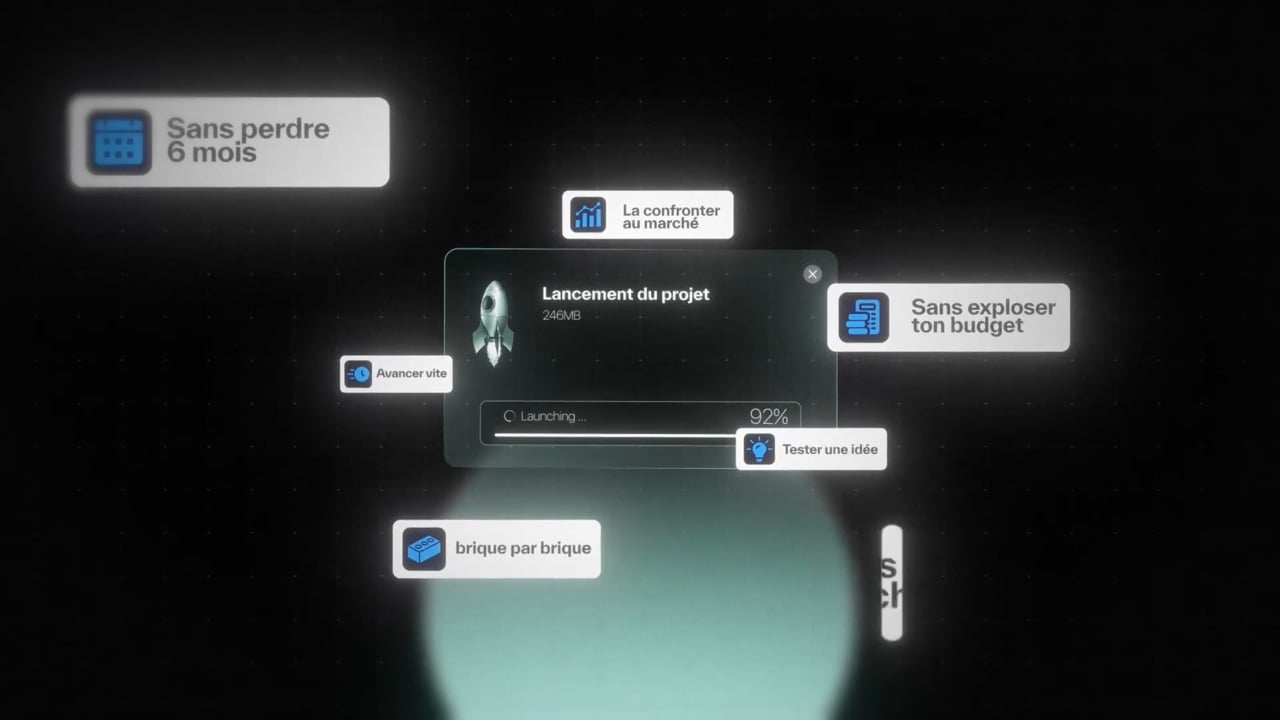
| Motion design | A voiceover | The entire voiceover and every on-screen text | The visuals, set afterwards in the storyboard |
| VSL | A voiceover, over an animation | The entire sales pitch | The hook variants to test |
Corporate video: a common thread, then one stage per part
A corporate video presents an organization, its business, its teams. Its risk is turning into an inventory. The script avoids this by first choosing a common thread (the stages of a project, of a customer journey, of a day), then giving a single stage to each part.
- The opening: the point of view of the target audience, their project or their problem, rather than the company’s history.
- The thread: the viewer quickly understands where the film is taking them.
- The parts: one stage each, entrusted to the person best placed to talk about it.
- The proof: for each part, what the camera will show (gestures, places, documents).
- The conclusion: the promise kept, then a single call to action.
Customer testimonial: an interview guide, then an editing script
For a testimonial, the script exists twice. Before the shoot, it is an interview guide. Afterwards, it is an editing script, written from what the customer actually said.
- The interview guide: the themes, the questions and what each answer must bring to the story.
- The transcript: all the answers written out, with their timecodes.
- The editing script: the sentences kept, in the order of the story, with the shots that cover them.
- The length check: the total of the answers kept, compared with the word budget in the table.
Choosing the customer, the questions and the follow-up questions are covered in detail in our guide to filming a customer testimonial, and the video customer testimonial page presents how we produce it.
Motion design: every word of the voiceover is written
In a motion design video, nothing exists before the text: the animation is built on the voiceover. The script is therefore complete, down to the word, and approved before the storyboard. At Biux, a 60 to 90 second 2D motion design video includes the script, storyboard, illustration, animation, voiceover and sound design, for €2,500 to €6,000 excl. VAT according to our price grid; it is delivered 15 days after the storyboard is approved.
- The hook: the viewer’s situation or question, from the very first seconds.
- The problem: what it costs, in one or two sentences.
- The solution: what the offer does, without internal jargon.
- How it works: two or three steps, one per animated sequence.
- The benefit: what changes for the user.
- The call to action: a single action, spoken by the voice and displayed on screen.
Write what animates next to each sentence. The storyboard then starts from a clear intention, and the on-screen text does not repeat the voiceover word for word.
VSL: a sales pitch written from the objections
A video sales letter does the work of a first sales meeting. Its script is built from the objections your sales team already hears, and each sequence deals with one of them.
- The hook: the prospect’s problem, named the way they put it themselves.
- The cost of doing nothing: what this problem makes them lose.
- The offer: what you propose, in one sentence.
- The objections: one sequence per objection, with its answer.
- The proof: a customer case, a demonstration, a verifiable fact.
- The call to action: the next concrete step, for example booking a call.
Write two or three different hooks in the script itself. A VSL is measured by view rate and click-through rate: the best opening is chosen on those figures, not in a meeting.
Interview script: write the questions, not the answers
When the person being filmed is not an actor, writing their lines for them has the opposite of the intended effect: they recite, search for their words, and the takes pile up. An interview script contains something else.
- The intention of each part, in one line, in the third person: “she explains what happens once the contract is signed”.
- The questions that lead to this intention, open-ended, one idea per question.
- The planned follow-up questions if the answer stays general: ask for an example, a case, a figure the person can source.
- The terms to use: the technical vocabulary the person must use correctly, and the vocabulary to avoid (internal jargon, names of confidential projects).
- The target speaking time for each part, converted with the table above.
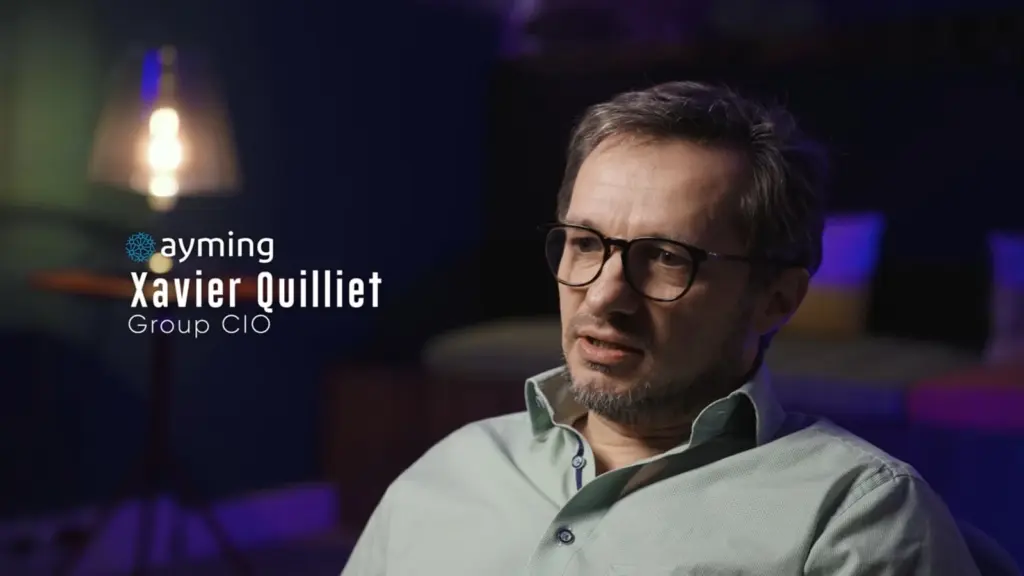
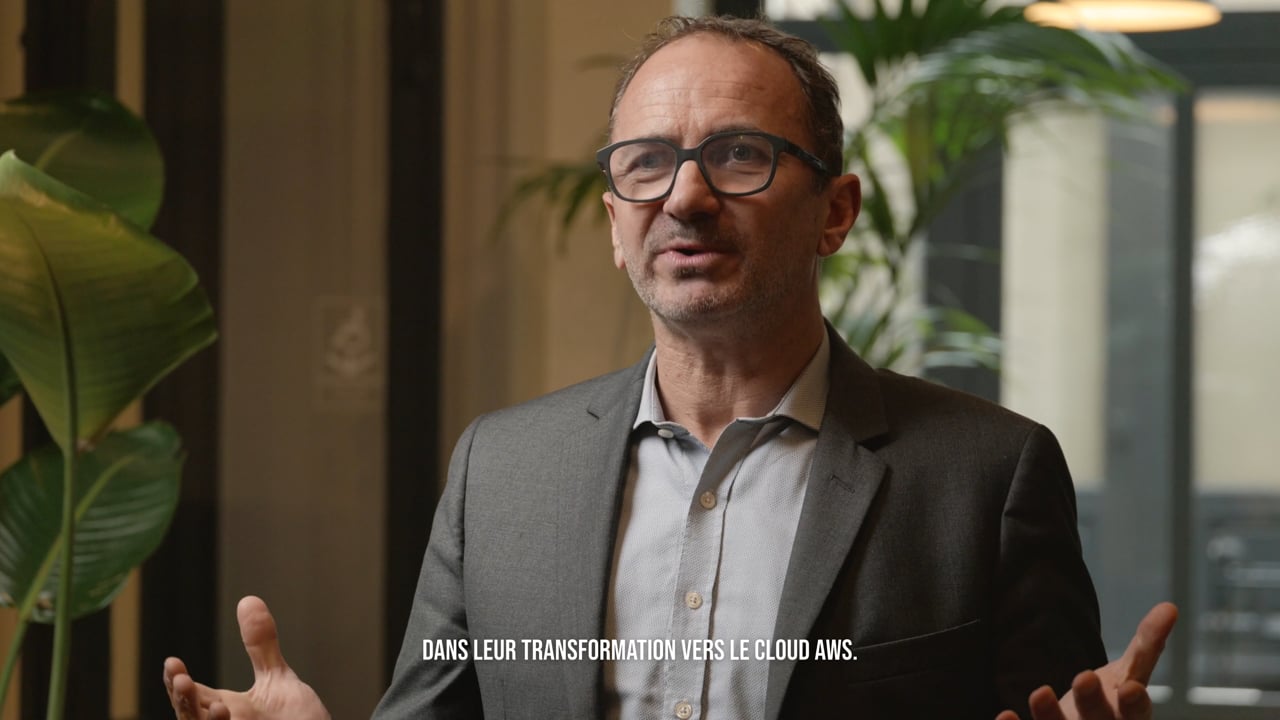
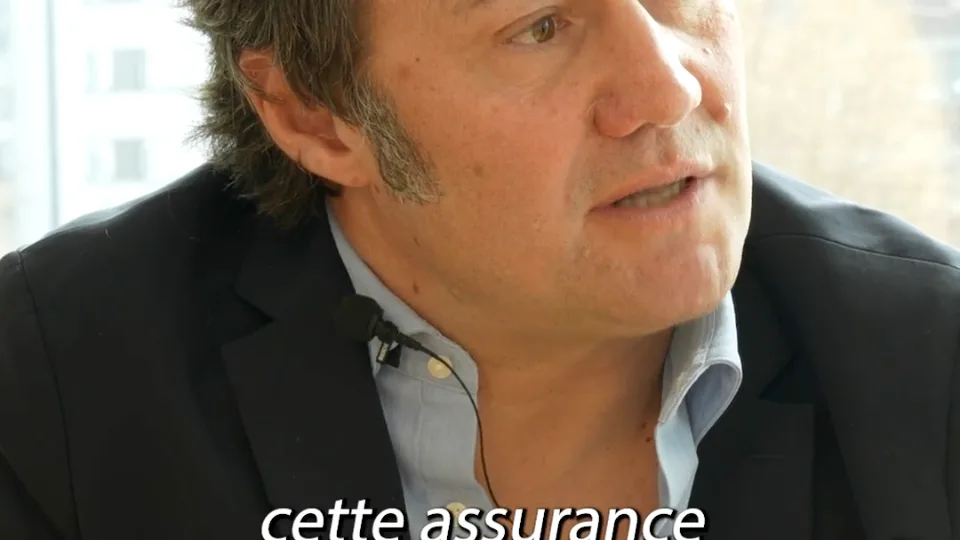
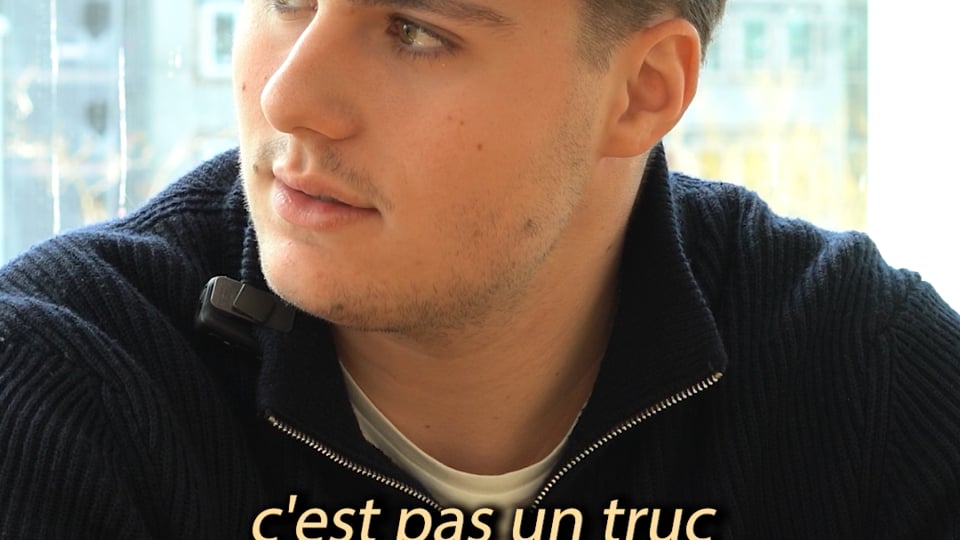
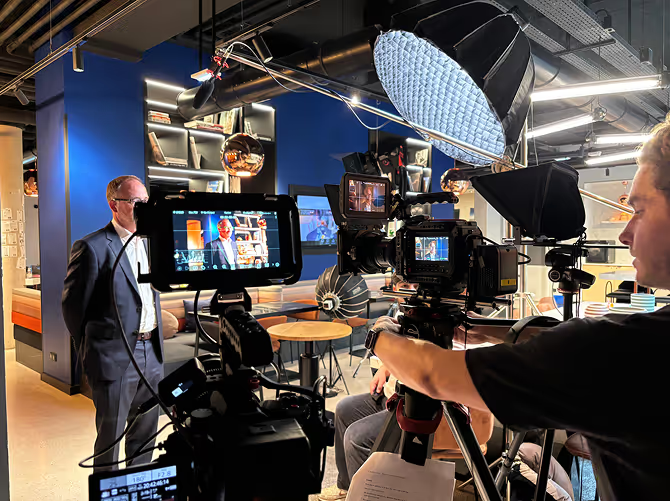
The Accor film is an example: the four speakers were filmed in interviews, with no teleprompter and no artificial staging. To prepare the person themselves, see our guide to preparing a video interview; the video interview page shows how we give a voice to executives, experts and employees.
A real annotated script: the Accor D&TS film
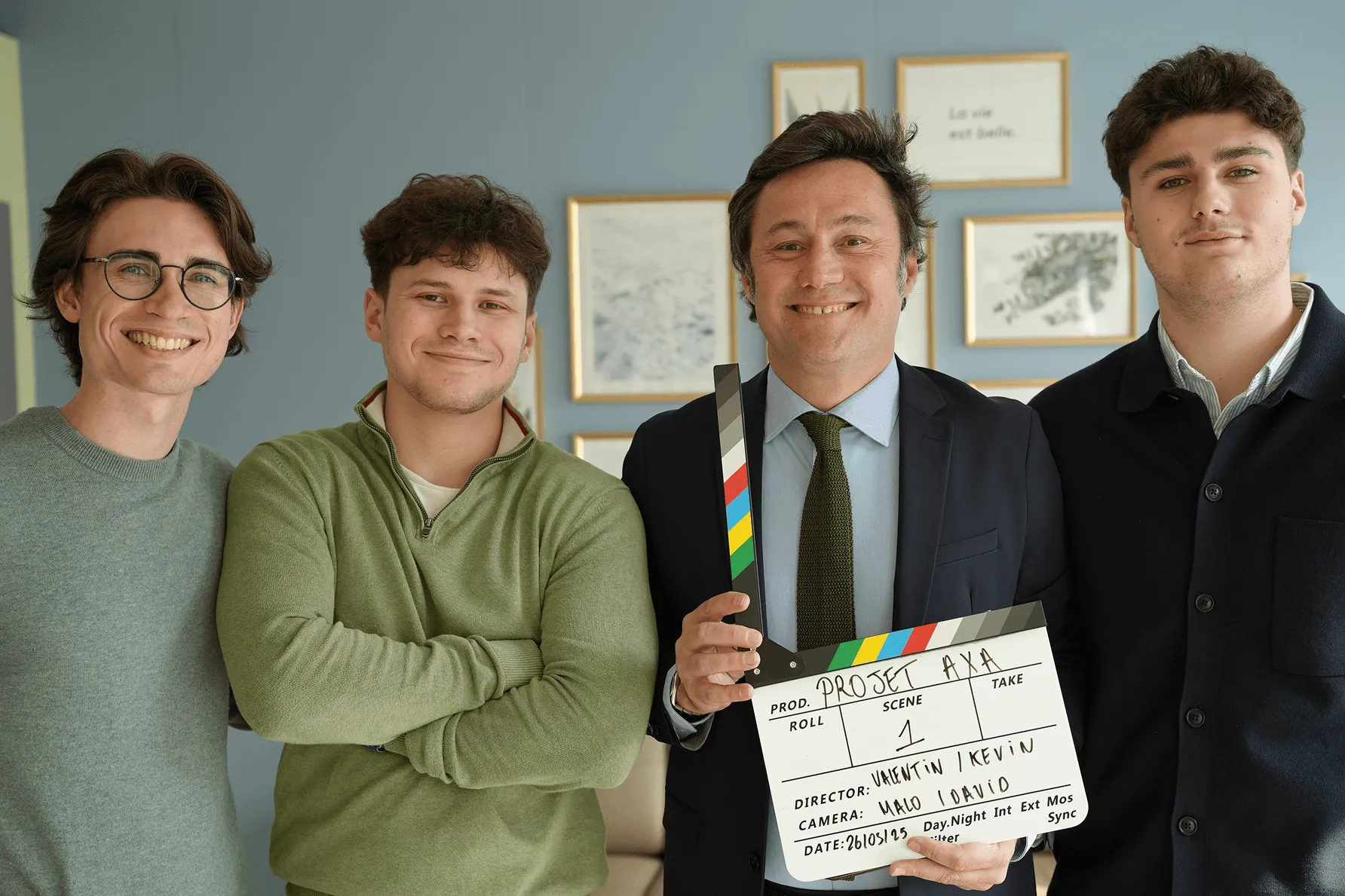
Accor entrusted Biux with the mission film for its Design & Technical Services division, for its Premium, Midscale & Economy branch. The brief asked us to show what these teams accomplish every day, through the voices and faces of the people who work there. The note of intent summed it up in one sentence: this film had to be “a story about people, not a corporate presentation”.
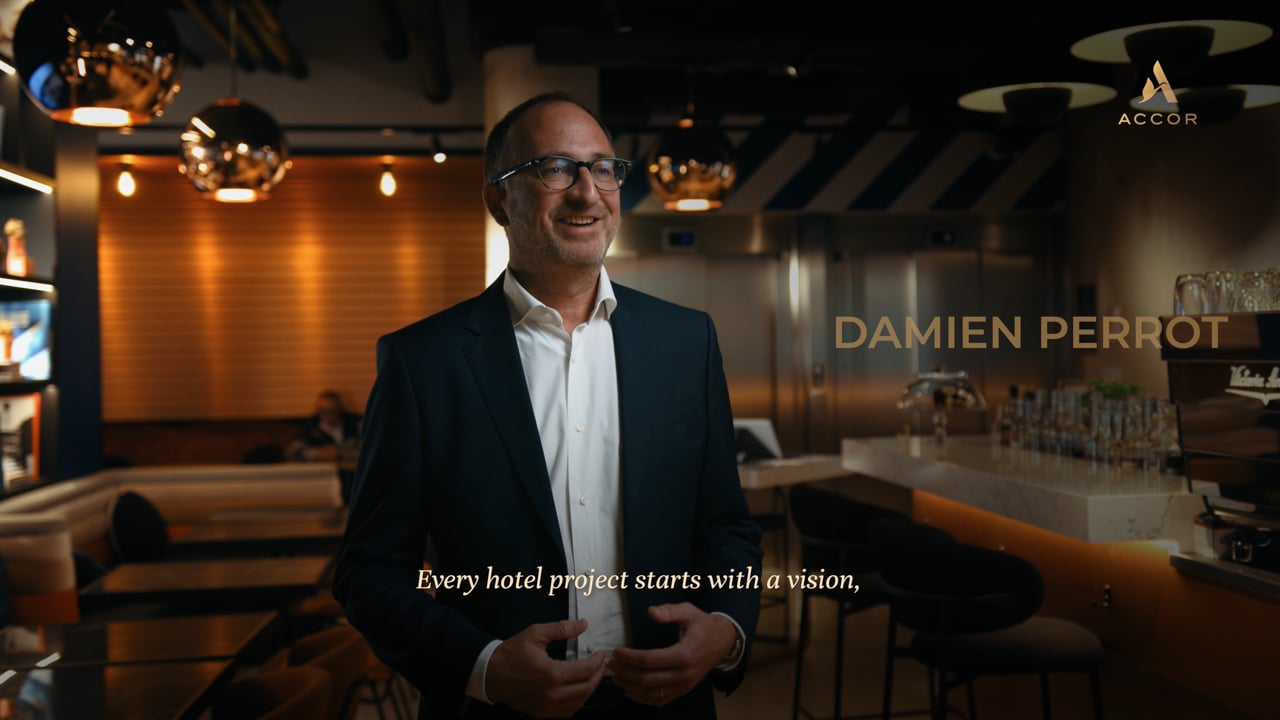
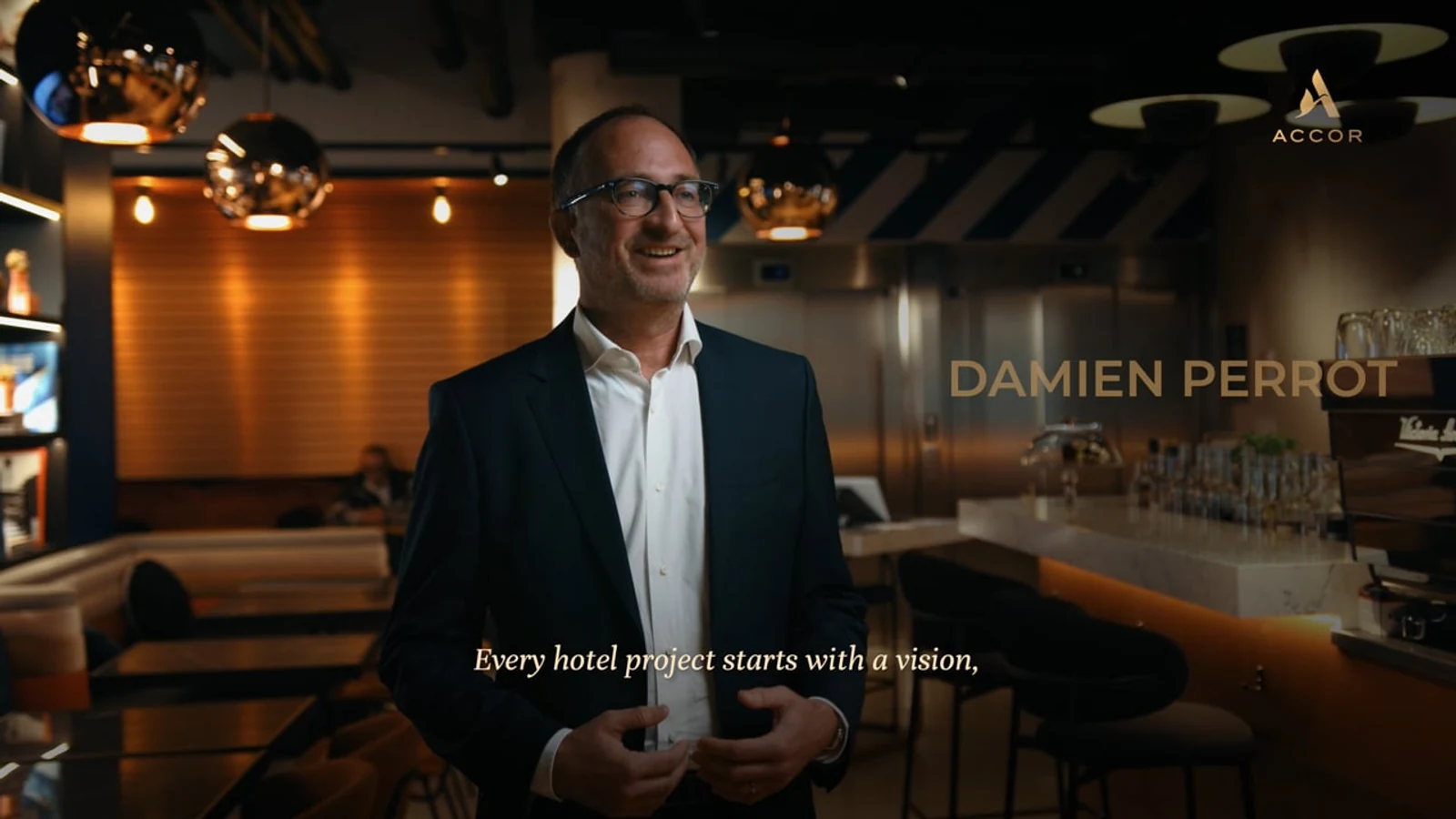
The Accor D&TS corporate film made by Biux follows a hotel project from idea to opening, in seven parts carried by four of the division’s experts, filmed at the Tribe hotel in Saint-Ouen and in São Paulo. Between the parts, a 3D animation shows a hotel being built.
The script, part by part
The script has seven parts, each corresponding to a stage in the life cycle of a hotel project. The table summarizes what each part says according to the project page, without putting words in the speakers’ mouths, then what you can take from it for your own script.
| Part | What the part says | Its role in the arc | Why it comes here | Takeaway for your script |
|---|---|---|---|---|
| 1. The opening, by Damien | A hotel project is born from a vision, a commercial ambition and a location. Accor gets involved from the first discussions, before signing, without losing sight of the owner’s budget and return on investment. | Set the framework and build trust. | A project’s cycle begins before signing. | Open with your audience’s project (here, the owner’s), not with your company’s history. |
| 2. After signing, by Lara | Lara becomes the owner’s dedicated contact: project kickoff, aligning stakeholders on the vision, schedule and deliverables, brand standards, site assessment, recommendation of key consultants. | Put a face on the support and open up the global dimension. | The second stage of the cycle. Filming it in São Paulo was, according to the page, a narrative decision, not a logistical one. | A shooting location can carry a message without a single line of text: note it in the picture column. |
| 3. Design, by Arun | A design brief true to the brand’s DNA and the owner’s objectives, approval of the plans down to the furniture, selected suppliers, materials, samples, mock-ups. | Bring the viewer into the profession, as a process where every decision affects the future guest’s experience. | Once the team is in place, the project takes shape on paper. | Link each task to its consequence for the end customer: a list of services becomes a process. |
| 4. Technical choices, by Martin | Regulatory monitoring, high-performance systems for safety, energy and water, clear technical guidelines for the construction sites: what protects the owner’s investment and the building’s environmental future. | Raise the stakes: the page describes this stage as the one where a mistake can cost months of delay. | Technical choices follow design and precede construction. | For each technical topic, write what it protects. Without this consequence, the part becomes an inventory. |
| 5. Construction, by Lara and Martin | Coordinating consultants, site visits and reviews, compliant solutions when conditions on the ground require adjustments, approval of the model room and public spaces. | The vision becomes tangible, and Accor stays involved to the end. | Construction follows the technical choices; the two voices already heard come together here. | When a stage involves two areas of expertise, share it and state in the script who says what. |
| 6. Pre-opening, by Lara | Final compliance visits, coordination with the operational teams (from IT to food and beverage, from purchasing to rooms), and support that continues after the opening. | The resolution, which plays out in the details. | The last stage before the doors open. | Bringing back someone already introduced avoids a new introduction and shows continuity. |
| 7. The conclusion, by Damien | From idea to opening, D&TS is there at every stage: the owner saves time and money, the brand stays consistent, performance lasts over time. The film ends with a direct invitation, addressed to anyone who wants support, wherever they are in the world. | Close the circle and turn the story into a commitment. | The voice that opened the film closes it. | Write the ending at the same time as the opening: same voice, promise kept, a single invitation. |
What the script carried besides the text
- Two languages from the writing stage. The script was written in English, then fully translated into French, with a list of the essential technical terms for each section. If your film is subtitled in several languages, this list prevents a term from changing from one version to another.
- A final version that assigns each contribution. The third version of the script, bilingual, assigns each speaker to their contributions. The project page describes it as the editorial backbone of the project.
- A structure visible on screen. Between the parts, the 3D animation adds blocks and floors to a hotel model; a miniature version of this timeline stays on screen during each part. The script’s breakdown becomes a landmark for the viewer.
- A storyboard aligned with the script. Its seventeen pages include, for each part, the script, the narrative intention, the inserts, the shot sizes and the framing.
The 7 script mistakes that make a shoot longer
These mistakes often get past proofreading. You pay for them on the day of the shoot, then in the edit.
- A text longer than the running time. The crew films everything, then cuts in the edit, and approved passages disappear. Count the words before approving, using the table above.
- Sentences written to be read. A sentence that cannot be said in one breath means another take. One idea per sentence, acronyms explained, and a read-through aloud by the person who will speak.
- An empty picture column. With no indication of what covers each passage, the crew looks for its shots on site: locations not booked, documents nowhere to be found, people absent. Note for each part what is shown and where. Anyone recognizable must have given their consent: see our article on the employee image rights release.
- A text given to the wrong person. A speaker who has no legitimacy on a subject hesitates, and the viewer notices. Assign each part to the person who does that job, as in the Accor film.
- Facts approved after the shoot. A figure corrected or a term disputed after the fact means reshooting the sentence or cutting it. Have each part proofread by the expert concerned before the shooting day, with the list of their technical terms.
- Several versions of the script on set. When a second and a third version are circulating, the director and the speaker are not working on the same text. Number the versions and bring only the latest approved one.
- The forgotten short version. A short or vertical version is prepared at the shoot, with suitable framing and sentences that stand on their own. Mark in the script the passages that will make it up.
Do you have a brief and a running time in mind? Describe your project in two minutes: Biux will reply with a detailed quote within 24 hours.
The 2-column script template
The classic audiovisual script fits into two columns: picture on the left, sound on the right. We split these two columns into five, so that no information gets lost between writing and shooting.
| Column | What goes in it |
|---|---|
| Time | The estimated start and end of each part, then the total to compare with the word budget. |
| Picture | What is seen: person filmed, location, illustrative shots, animation, transitions. |
| On-screen text | Names and job titles, part titles, figures displayed, subtitles, mandatory notices. |
| Voice or interview | For a voiceover, the text word for word. For an interview, the intention of the part and the question that leads to it. |
| Sound | Music, ambient sound, silences, sound effects. |
Here is the first part of the Accor film filled in using this template, with only the information published on its project page.
| Time | Picture | On-screen text | Voice or interview | Sound |
|---|---|---|---|---|
| Part 1 of 7 (timing not published) | Damien in an interview, main shoot at the Tribe hotel in Saint-Ouen. 3D animated transition to the next part. | Subtitles in French and English. Miniature 3D timeline on screen. | Intention: a hotel project is born from a vision, a commercial ambition and a location; Accor gets involved before signing, without losing sight of the owner’s budget and return on investment. | Original musical score (piano, strings) and discreet documentary ambient sound. |
Get the 2-column script template (Google Docs): the five columns, usage instructions, checks before approval and the Accor example filled in across its seven parts.
To go further
The script fits between two steps: the video brief, which comes before it, and the storyboard, which comes after it. To place these steps in the project as a whole, see our method for making a business video, and our guide to video storytelling to choose the story before writing it.
Are you preparing a film in which your teams speak? Discover our approach to the corporate video, from writing the script to delivery, 15 days after the shoot.