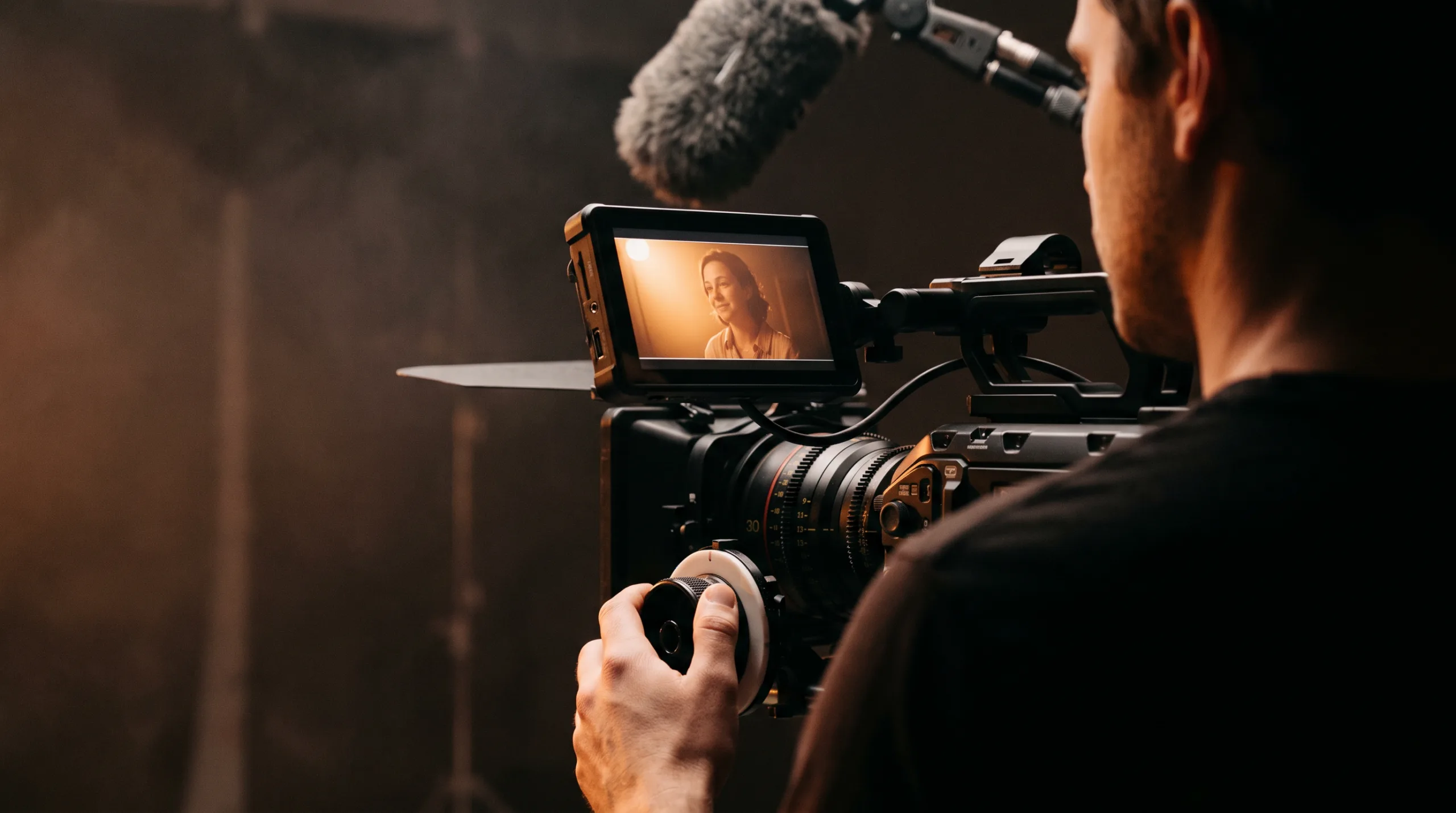

A video client testimony provides concrete evidence to a B2B prospect: a person tells about his or her initial problem, his or her collaboration and the results observed. To turn it, choose a client relevant to your target, prepare open questions and care for the sound. The editing must then return its experience without turning its answers into recited commercial discourse.
You still need to know how to film it. Poor framing, weak audio and a customer reading answers from a sheet are common and costly mistakes. This article covers customer selection, interview questions, filming and editing. The aim is to produce a testimonial that supports your sales process.
Why the video outweighs the testimony written in B2B
What a B2B decision maker sees before signing
The B2B buying cycle is long. Between the first contact and the signature, a decision-maker consults on average several providers, compares quotes, reads case studies and seeks evidence that his investment is justified. The text testimony reassures. Video, on the other hand, creates something fundamentally different: projection.
When a sales director sees a peer from the same sector explain how they solved a similar problem, the message becomes more than a promise: they recognise their own situation. This sense of identification is what text cannot reproduce in the same way.
The data confirm this use: in 2026, 91% of companies use video as a marketing tool and 57% of video marketing professionals have already produced video testimonials. The question isn’t "do you have to do it?", it’s "how do you do it?".
To place this format in a broader strategy, the Corporate Video responds to another need (company presentation, values, history). The customer testimonial directly addresses the prospect’s objection at the end of the purchase journey.
Video vs. written testimony: what changes in perception
A text review can be written by anyone. A video is not invented: the face, the tone of voice, the customer’s micro-expressions are all signals of authenticity that the brain instinctively analyzes. This is what communication researchers call para-verbal credibility: what convinces is not found in the words, but in the way they are pronounced.
In concrete terms, this means that85% of consumers were convinced to buy a product or service after watching a branded video. In B2B, this figure makes even more sense when the stakes are an annual contract or a multi-thousand-euro service.
An authentic and slightly imperfect testimony convinces more than a perfectly recited testimony. The video captures this natural imperfection. The text erases it.
Choosing the Right Interviewed Client
The ideal profile: 3 criteria to cross
Before we think about filming, the central question is: who is filming? This choice determines the effectiveness of everything else.
Criterion 1: The customer should look like your target prospects. Industry, company size, decision-making role and initial problem all matter. If your target prospect is the marketing director of a tech company with 30 to 80 employees, interview someone with that profile. Identification comes from a recognisable situation.
Criterion 2: Client must be able to cite documented results. A general satisfaction ("that was great, I recommend") has a low commercial value. A client who describes a concrete change in his or her business provides more useful evidence. Ask him for an experienced example and add a figure that if he can explain the source and the scope.
Criterion 3: The client must be comfortable speaking, or ready to prepare. The ease in front of the camera is not innate. A customer who agrees to be briefed and who has read the questions in advance will give better answers than a brilliant customer but taken by surprise.
How to convince a client to testify
The main objection of a client asked for video testimony is the time: "I don’t know how much it takes", "I don’t want to make a bad impression". Answer this objection before it is formulated.
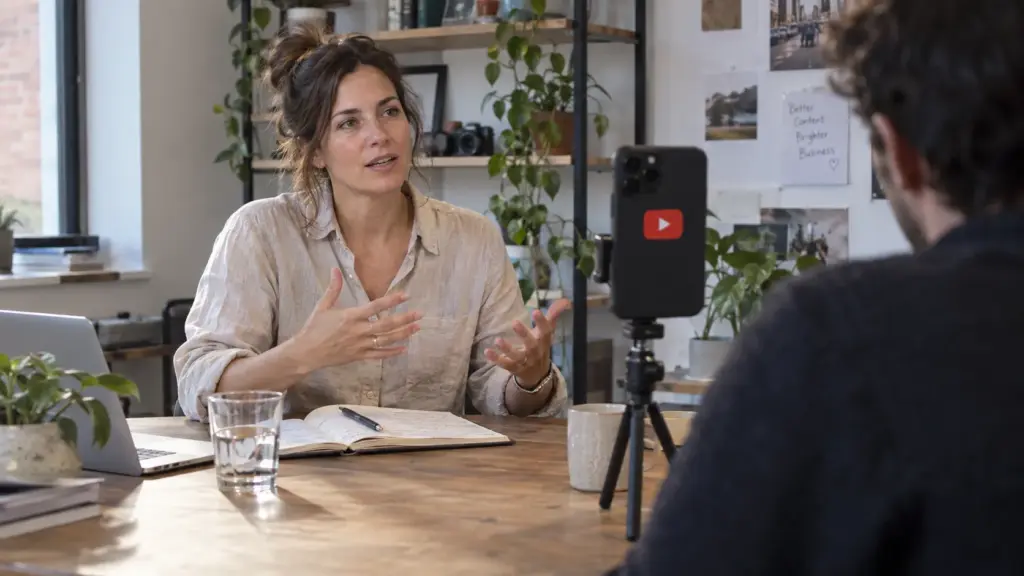
Present the project as mutually beneficial: the video showcases the customer’s expertise, role and business as well as your work. Explain the process, including advance preparation, a shoot lasting no more than one and a half to two hours and no script to recite. Allow enough time for natural answers.
On the logistics side, propose to move to its premises. It’s more comfortable for him and it gives a visual context relevant to the video. For projects carried out in Ile-de-France and within a radius of about 1h30 around Paris, Biux provides on-site travel with complete equipment. Final delivery takes place within 15 days after filming.
Le Reply x Ayming testimony shot by Biux Gives the client the floor on his/her collaboration. It illustrates the choice of a stakeholder who can present the context and experience, beyond a general recommendation.
Preparing for filming: brief, location, material
The pre-tournament brief with the client
A successful testimonial starts before filming. Send the questions in advance with an outline of the themes, not a script to memorise. The customer can prepare examples, figures and anecdotes. On the day, knowing what to expect helps them feel more at ease.
Agree on three core themes: the initial problem, the collaboration and the results, using concrete and measurable examples where possible. Specify whether the video will appear on the website, LinkedIn or in sales presentations so its tone and length suit the audience.
Choosing the right place and taking care of the frame
Location is an element of credibility that is often underestimated. There are four rules to avoid the most frequent mistakes.
Coherence decor / activity. A SaaS startup founder filmed in a modern open space visually anchors his profile. A restaurateur filmed in the kitchen talks to another restaurateur. Avoid neutral meeting rooms if the client has a work environment that is more representative of their business.
Acoustics before aesthetics. Test the location 10 minutes before shooting, helmet on the ears. Open spaces during rush hour, rooms with echo, rooms close to a kitchen or a noisy server are to be avoided. The sound is very difficult to correct in post-production.
Brightness. A window positioned on the side (90 degrees from the subject) provides flattering natural light. Avoid direct backlight (window behind the subject). If the natural light is insufficient, LED panels complement effectively.
Clean and consistent background. A slightly blurred neutral background or an orderly work environment. Avoid sterile white walls and overloaded decorations (posters, post-its, visible cables).
The minimum material for a professional rendering
A common mistake is investing in the image while neglecting audio. A familiar production principle is that viewers tolerate an imperfect image more readily than poor sound. Slightly underexposed footage can remain watchable, while distorted audio or room echo makes a video difficult to follow.
His (absolute priority): Use a wireless or wired lavalier microphone positioned 15 to 20 cm from the speaker’s mouth, under the collar or on a tie. A camera or smartphone’s built-in microphone captures too much background sound. It may suit informal content, but not a B2B sales testimonial.
Image: New generation camera or smartphone attached to tripod. The minimum resolution is 1080p. The portrait mode of a recent smartphone is enough to blur the background without requiring dedicated optics.
Lighting: a kit of two LED panels (main light + counter light) allows to work in any place whatever the weather. For indoor shooting with favorable natural light, a white reflector is enough to complete.
This equipment provides a basic professional setup. A B2B video agency can add a cinema camera, boom microphone, assistant and experienced interview direction, which helps bring out useful answers.
Questions to ask during the interview
The Narrative Structure in 3 Times
All the best customer testimonial videos follow the same narrative structure, whether it’s clearly formulated or not: before / during / after. It is the most universal narrative pattern, the one that the viewer naturally follows without effort.
Before The context and the initial problem. The customer existed before he knew you. He had a situation, a constraint, a problem to solve.
During : choice and collaboration. Why this provider rather than another? How did the work go together?
After : the results and recommendation. What has changed? What would this client say to a colleague who asks the same question?
This structure guides the selection of questions and the final editing. It is also the common thread to guide the interview in real time.
Le Customer testimonial A4 Concept produced by Biux stages a return to experience. It allows us to observe how the client’s word can carry the story, a logic to keep when questions move from context to results.
12 Typical Questions for a B2B Video Customer Testimonial
These questions are starting points, not scripts. Keep the interview conversational and begin filming once the customer feels comfortable, often after five to ten minutes of informal conversation off camera.
Block 1: context and initial problem
| # | Question | Objective in the video | Reformulation if the answer is too short |
|---|---|---|---|
| 1 | "Can you introduce yourself in a few words: your role, your company, your sector?" | Anchor the credibility of the witness and the identification of the prospect | "And in your sector, what makes your activity particularly demanding?" |
| 2 | "What was the situation before working with us? What problem were you trying to solve?" | Identify prospects who are experiencing the same problem | "Actually, what was it blocking or slowing down in your communication?" |
| 3 | "What had you tried before? Why didn’t it work?" | Qualify the alternatives explored and strengthen the legitimacy of choice | "Is there any reason why you delayed this decision?" |
Block 2: the choice and collaboration
| # | Question | Objective in the video | Reformulation if the answer is too short |
|---|---|---|---|
| 4 | "Why did you choose to work with this agency rather than another solution?" | Collect the differentiation argument in the customer’s mouth | "Is there any element that made the balance bend?" |
| 5 | "How’d the shooting go? What surprised you?" | Dedramatize the camera and reassure future customers about the process | "Is there anything you didn’t expect to find in this collaboration?" |
| 6 | "Is there a moment of the project that you particularly remember?" | Get a memorable and human anecdote, exploitable in teaser | "A moment that clearly illustrates how the project took place?" |
Block 3: results and recommendation
| # | Question | Objective in the video | Reformulation if the answer is too short |
|---|---|---|---|
| 7 | "What results have you seen since the video was released?" | Concrete, measurable evidence: the key question for the edit | “Can you give a concrete example, such as a prospect’s reaction or an unexpected use?” |
| 8 | "In what context do you most often use this video today?" | Illustrate the real use (commercial presentation, email signature, LinkedIn) | "Did you send her to prospects before an appointment?" |
| 9 | "Did it change anything in the way your prospects perceive you?" | Measuring Brand Impact Beyond Direct Results | "Did you have any unexpected feedback?" |
| 10 | "If you were to recommend this to a colleague, what would you say to him?" | Obtain a closing statement that provides the testimonial’s implicit call to action | "What would you tell him to convince him to start?" |
| 11 | "Is there anything you hadn’t anticipated, good or bad?" | Showing honesty, strengthening credibility. Breaking the image of too polite testimony | “Did anything surprise you during the project, positively or otherwise?” |
| 12 | "How would you describe the agency in three words?" | Get a short and impactful excerpt exploitable in teaser or visual quote | "3 words that summarize your experience?" |
This template structure the interview, it does not stiffen it. Out of 12 questions, 6 to 8 usable answers make up a 2 to 3 minute well-assembled video. The other 4 serve as raw material for short formats or variations.
To adapt the frame to your sector and prepare the restarts, find our selection of questions for a video client testimony.
The day of the shoot: framing, sound and interview direction
The 3 rules of framing for an interview that inspires confidence
The framing of an interview is a matter of psychology as well as technique. A poorly thought-out setting generates discomfort, which the viewer feels without being able to name it.
Rule 1: Chest plan. Frame head higher up the bust. The single-headed close-up is intimidating on a non-comedian; the broad plan drowns the subject in the setting. The chest plane isolates the subject and gives space to the facial expression without exposing it.
Rule 2: three-quarters, not face direct camera. Ask the customer to sit slightly off the camera axis and look at the interviewer beside the lens rather than behind it. This eyeline is more natural for someone unused to filming and more comfortable for the viewer.
Rule 3: Blur the bottom slightly. A shallow depth of field (portrait mode on smartphone, wide aperture on camera) isolates the subject and gives a cinematographic appearance even with modest equipment. The bottom exists but remains secondary.
Healing the sound before the image
The golden rule, recalled here because it is too often ignored: the viewer forgives an imperfect image, not a bad sound.
Before you start filming, do 30 seconds of test recording as you listen to the headphones (not the speakers). What you hear then is what the viewer will hear. Check: no echo, no buzzing air conditioner or refrigerator in the background, no saturation when the customer is talking loudly.
Place the lavalier microphone 15 to 20 cm from the speaker’s mouth, under the collar or on a tie. Avoid rough jacket fabric that rubs against it, and switch off sources of electrical noise in the room where possible.
Putting the client at ease: interview management
It is the skill that separates a professional production from an amateur shoot, and it is the main gap of all other testimony formats (text, audio, self-capture).
Start with straightforward questions about the speaker, their role and the business before discussing results or recommendations. This helps the customer find their rhythm, relax and gradually forget the camera.
Reword out loud what the customer has just said ("So if I sum up, before you start this project, you were having trouble…"): this technique invites the customer to validate the reformulation, to clarify its purpose or to go further. The best answers often come in these revivals.
Explicitly allow another take: “If you are not happy with an answer, we can start again.” Knowing they can try again takes the pressure off the customer. Often, that reassurance is enough.
At Biux, the director is trained to conduct B2B interviews, not just technical ones. Getting a customer to speak naturally in front of a camera is a skill in its own right, different from mastering optics or editing.
From editing to broadcasting
Structure the montage on the narrative, not on the timeline
A common mistake: mount the video in the order in which the questions were asked. The result is a video that looks like a report, not a story.
Build the edit around the story’s before, during and after, selecting the three or four strongest answers from the twelve questions. A focused two-minute edit is more useful than six minutes of exhaustive detail. The viewer needs enough information to decide whether the supplier is worth a meeting.
Graphics support the narrative through subtitles, the customer’s name and role, their company logo and restrained background music. These elements make the presentation more professional and help establish who is speaking.
This video of personal branding AXA made by Biux illustrates the editing of a speech for networks. It is not a customer testimonial: it is used here to observe a short and incarnate format whose rhythm can inspire the variations of an interview.
Where and when to broadcast your video customer testimonial
A well-prepared shoot produces three distinct formats without returning a single image.
Long format (2 to 4 minutes) : website and landing pages. Embed the full version on the relevant service pages, where prospects actively researching a supplier can watch it. The video can communicate information that would otherwise need several paragraphs.
Short format (30 to 90 seconds) : LinkedIn native and prospecting email. On LinkedIn, upload the video directly (without a YouTube link that reduces algorithmic reach). In commercial emails, a clickable thumbnail with play icon is enough to multiply the opening and clicking rates.
Short vertical format (10 to 20 seconds) 9:16 for LinkedIn mobile, Instagram Stories, or visual quote with the answer to question 12 ("3 words to describe the agency").
Plan these three formats before filming. They use the same source footage, with a different edit for each use.
To go further on the production of videos of customer cases, discover our customer testimonial production service and the formats we produce.
You’re planning the shooting of a client witness? Describe your project in two minutesBiux returns to you with precise cost estimate.
FAQ: Frequently asked questions about shooting a video customer testimonial
How to make a good customer testimonial video in B2B?
Structure the story around the initial problem, collaboration and results. Choose a customer whose profile matches the target prospects and who can give concrete examples. Prepare the questions without imposing a script, and prioritise sound. Natural hesitation and spontaneous phrasing make a testimonial feel more authentic than a memorised performance.
What should be included in a video testimonial for it to be effective?
Five elements must appear in the final editing, in this order or adapted according to the style of the client: a trigger (why this client had a problem and was looking for a solution), the concrete problem and its impact on the activity, the solution chosen and the reasons for this choice, measurable or observed results, a final recommendation addressed to a colleague. These five elements form the minimal narrative structure of a converted testimony.
How long should a video customer testimonial last?
Plan three formats before filming: a two-to-four-minute version for the website and landing pages, a 30-to-90-second version for LinkedIn and sales emails, and 10-to-20-second clips for social channels and presentations. All can use the same footage if their needs are covered in the brief and shoot.
Can you make a video customer testimonial without an agency?
Yes, for informal use (internal social networks, sharing in meetings). On the other hand, for a B2B commercial use (website, response to a call for tenders, presentation to decision-makers), professional quality becomes decisive. A mediocre sound or absent interview direction destroys the credibility that testimony is supposed to create. The rule is simple: if this content must convince a prospect to invest several thousand euros, it deserves a level of production up to this challenge.
How much does a video witness at Biux cost?
This production includes customer interview, illustration plans, narrative editing and a short version. The estimate specifies the stakeholders, locations and deliverables; Biux pricing guide present this scope.
How long will it take for a customer witness to be given?
Biux delivers customer testimonial within 15 days after filming. Prepare upstream the choice of the speaker, his availabilities, access to the place and the subjects of the interview. Also designate the person who validates the customer’s information to organize the return on the editing and the intended release versions.
To go further
Filming a B2B customer testimonial requires care at every stage: customer selection, preparation, location, framing, interview direction and narrative editing. Decisions at one stage affect the others.
If you want to delegate this production to a team that masters both the technique and the conduct of B2B interviews, discover our approach to video customer testimonial and the formats we deliver in 15 days after filming.