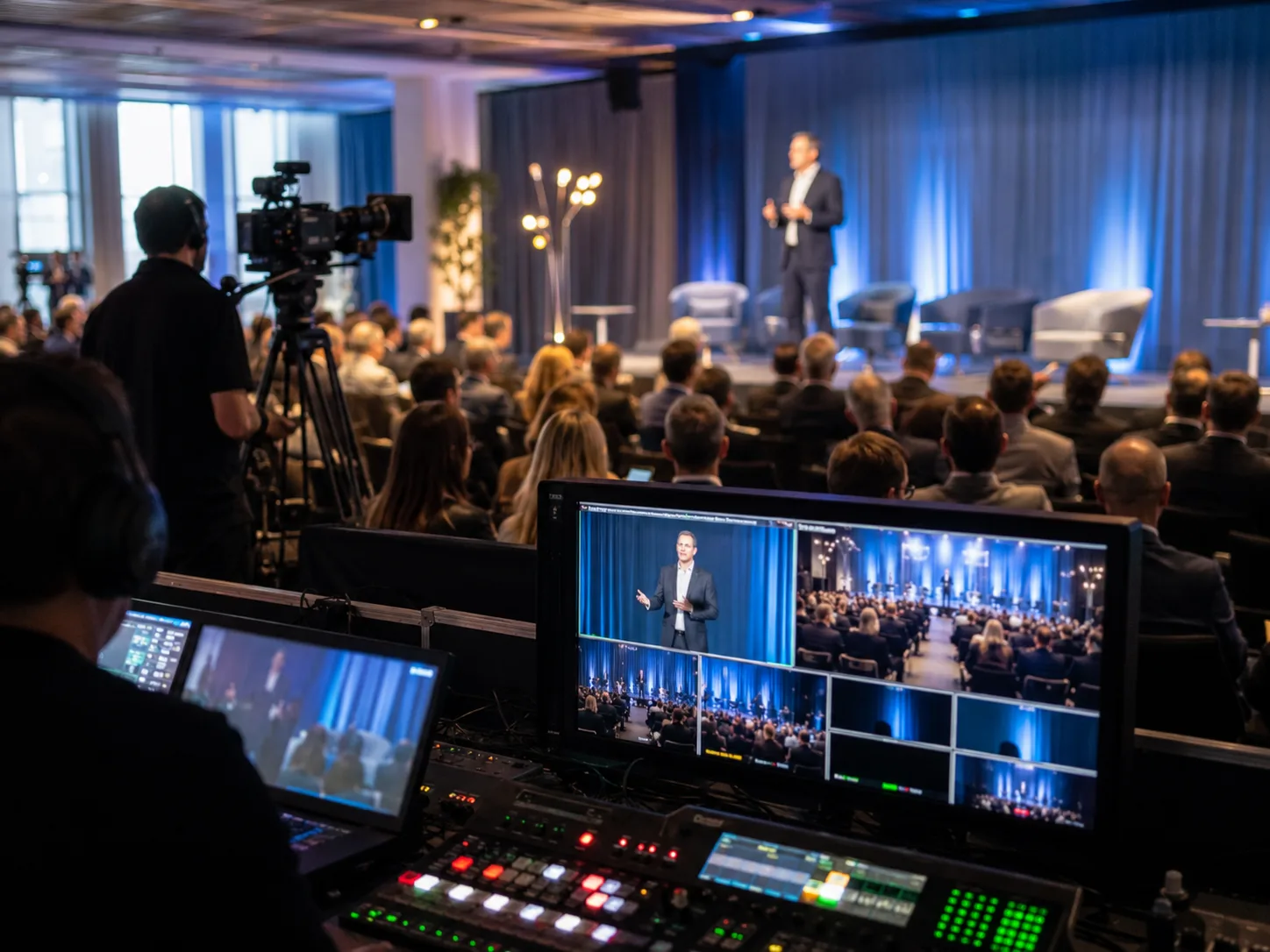

The video capture records an event to preserve its interventions and produce replays or excerpts. The number of cameras, the sound socket, the spaces to be covered and the deliverables determine the device suitable for your conference or seminar.
This article answers these questions concretely and without jargon. The goal: to allow you to arrive at a first exchange provider with the right information, and to calibrate your budget before requesting a quote.
What changed in 2026
Replay is no longer the only technical outlet for an online event. In its news of 31 March 2026, LinkedIn presents the creation of clips from a recording and a persistent broadcast key to prepare the directs. These features bring together capture, technical testing and release of extracts. They do not replace room tracking or editorial selection work.
For your next event, indicate in the driver the interventions to be kept in full and the passages that may become self-contained content. An excerpt must remain understandable without the preceding speech. Identify the players in the image, retrieve their media and plan to take the exploitable sound separately from the reactions in the room.
Backup remains a production task. YouTube recommends a local record to complement its archive. Keeping these files allows you to resume editing, correct a title, or make a version for your intranet. So decide before the filming that keeps the sources, that validates the extracts and that publishes the final versions.
What is video capture?
Technically, video recording refers to the audiovisual recording of an event in real conditions, without prior scripting. The term is borrowed from the vocabulary of the performing arts, where it has long referred to the recording of concerts, plays or live shows. Its reference definition is set by Wikipedia in its Captation page (audiovisual).
In the corporate world, the term has expanded to cover professional events: conferences, seminars, round tables, product launches, general meetings. The principle remains the same: a film crew documents what happens on stage or in theaters, in real time, without complex prior control.
What distinguishes the capture of a classic video production is the absence of repetition. The technicians adapt to the course of the event. They do not have a second chance on a speech or a workshop sequence. This is what justifies the use of a professional service provider: the experience in real conditions is decisive for the quality of the rendering.
Corporate video and video capture: two distinct services
Video capture is often confused with corporate video, while they respond to different logics.
Un corporate film is built upstream: script, storyboard, shoots organized over several days or half-days, actors or collaborators briefed, long editing. It is a production in itself, with a controlled message from A to Z.
The capture, on the other hand, documents an event already programmed. She does not create it; she records it. The provider adapts to your drop-down, not the other way around. This distinction is important at the time of budgeting: a capture does not require heavy pre-production, but it requires a team able to react quickly and guarantee the quality of audio and live image.
Both formats are complementary. It is common to use a video provider to capture an annual seminar while also ordering an institutional film for the same event.
Video capture and aftermovie: same event, two different deliverables
The capture and the aftermovie often start from the same shoot, but they do not designate the same deliverable.
The capture is a complete document. It records the entire event: each speech, each sequence, with the direct sound. The final file can be used as an internal replay, archived on your intranet, or transmitted to absent participants.
L’Aftermovie Event, it is a synthesis film mounted. It selects the highlights, applies a music, a rhythm, a graphic design, and produces short content (1 to 3 minutes in general) valorizable on your social networks or your site. He doesn’t record, he tells.
In practice, capture is often the raw material of aftermovie. You can order both in a single service: the provider turns, completes the replay, and produces the aftermovie from the best footage. These are two deliverables with distinct goals, but they feed off each other.
Depending on your goal, you can complete the capture with a live streaming of company to reach participants at a distance or Aftermovie Seminar to restore the highlights after the event.
Types of B2B events suitable for video capture
Here are the main types of corporate events for which video capture is relevant, with for each the technical specificities to anticipate.
Conference and colloquium
A main speaker, slides, often an audience of 50 to 500 people. The video capture conference requires at least two cameras (wide shot on the room, close-up on the speaker) and a sound recording on the sound system of the room. If the event lasts several hours with several speakers who succeed each other, provide a system to relieve the operators or a fixed camera device.
Seminar and team building
The sequences follow one or two days, sometimes in several spaces. The seminar video capture is technically more demanding: the team must anticipate transitions, cover informal moments, and manage spaces whose lighting is not mastered. A device of two to three cameras with at least two operators is recommended.
Round table and CODIR
The main issue is audio. Several speakers speak at the same time or on the chain, around a table. An HF microphone or a pole per speaker is often necessary. Capture is about clearly identifying who is speaking and making each intervention intelligible.
Product launch and inauguration
These events are more dynamic: demonstrations, audience reactions, scripted moments. The provider must be mobile. A multi-camera device with a shoulder-to-shoulder camcorder and fixed-foot cameras generally covers this type of format well.
Webinar and hybrid event
Live capture here involves a real-time broadcast via a platform (YouTube, LinkedIn Live, Zoom, Teams). The provider simultaneously manages capture and stream encoding. It is a service distinct from simple capture, with additional hardware (encoder, software control) and an essential upstream technical verification.
General Assembly
AG has a legal dimension. The video recording of an AG produces an opposable document, which can serve as proof in the event of a dispute. Audio quality and full coverage of the session are non-negotiable criteria.
What determines the budget of a video capture
There is no single price for a video capture. The price of a service depends on several variables, here.
The number of cameras and operators is the first lever. A fixed camera can cover a simple speech; complementary angles facilitate editing and coverage of exchanges. The device and deliverables determine the estimate.
A multicamera device allows to alternate angles and keep a backup image during a scoping change. The estimate distinguishes the means of shooting, sound recording and editing work, without assigning a flat rate to each camera.
The duration of the event and the preparation time
The longer the event, the higher the cost. A service provider usually charges one day of filming (6 to 8 hours on site) plus editing hours. Events over several days are subject to a specific quote.
Adding a live broadcast to a capture requires additional equipment and technical testing. The direct device is encrypted according to the project, not as a lump sum supplement to be added to any capture.
The final deliverable: raw video or final editing A capture delivered in raw files and a mounted capture do not cover the same work. Subtitling, graphics, selection of interventions and variations must appear in the estimate to make the offers comparable.
Movement and tracing
For events outside Paris or requiring a technical scouting upstream (large conference rooms, atypical spaces), travel expenses and a half-day of scouting can be added to the estimate.
Rates published by Biux
La B2B video rate grid separates the following deliverables:
- Event capture: delivery within 15 days after filming.
- Live streaming: live streaming and replay delivered in 15 days after the event.
- Aftermovie: delivery 15 days after the event.
These services serve different purposes. For a project that combines them, ask for a common estimate detailing the mutualised means and the deliverables ordered.
How to prepare your video capture: 5 questions to ask your provider
Here are five concrete questions to ask when choosing your provider and framing your service. They help to avoid unpleasant surprises and obtain a relevant quote.
1. How many cameras are needed for my event?
The answer depends on the format: number of speakers, size of the room, presence of slides or demonstrations. Ask the provider to justify his choice. An undersized device delivers insufficient rendering; an oversized device increases the cost without added value.
2. Is the room sounded? If not, what impact on the quote?
Audio is often the weak point of amateur captures. A good service provider anticipates the issue of microphones regardless of the room sound. If your room is not sounded, providing HF microphones on foot or lavaliers adds to the estimate.
3. Do you want a live broadcast or only a replay?
These two scenarios do not mobilize the same material. If a livestream is considered, specify it upstream: the provider must provide the encoder, test the internet connection of the room, and ensure compatibility with your broadcasting platform.
4. What final deliverable do you expect: raw capture, final editing, network extracts?
This largely determines the budget. Being precise helps to avoid post-tournament negotiations. If you want LinkedIn snippets or a synthetic aftermovie in addition to the replay, mention it in the initial brief.
5. Is it possible to set up the day before or in the morning before the doors open?
The installation time impacts the quality of the filming and, sometimes, the price. A provider who installs the very morning of a stressful event is less available to check the technical focus. Anticipate this point with the room manager.
Video capture and reuse of content: maximizing the ROI of your event
A video capture of an event day produces several hours of rushes. These files are not only worth as a replay. Well exploited, they allow you to create several weeks of content from a single day of shooting.
Here is what can be produced from a standard capture:
- 4 to 6 LinkedIn extracts : short sequences (60 to 90 seconds) from the best speeches or moments of life of the event. Vertical or square native format depending on the platform.
- A full internal replay : accessible via your intranet or a private video platform for absent employees or remote teams.
- A synthetic aftermovie : a film of 1 to 3 minutes setting the highlights of the event, with music and graphic graphics. Broadcastable on your site, your newsletters or at the opening of the next event.
- Teasers from 15 to 30 seconds : usable for presentation introduction or sponsored advertising on LinkedIn.
- Internal training modules : if the event included interventions with high pedagogical value (CODIR, business conference), extracts can be integrated into an e-learning training course.
- HR content and employer brand Internal life sequences (workshops, interactions between employees) directly feed into an internal communication or recruitment video content strategy.
This reasoning is important before ordering a performance. A capture used in replay, social extracts and in-house training meets several needs. Identify these uses in the brief to predict the necessary shots and versions, instead of discovering the limitations of the files after the event.
You can also prepare a teaser video to introduce the replay and give viewers a reason to watch the full presentations.
Example of event video capture
Biux made the capture and aftermovie of the event Amazon Web Services and Reply in Paris. This film shows the difference between recording the interventions and selecting the highlights for an event restitution.
Le merger film Next Mobiles and Mobile Club accompanies a company announcement. Here, it illustrates the deliverable of a full recording: the video carries a prepared message, instead of returning the entire event.
FAQ
What is the difference between video capture and aftermovie?
The video capture records the entire event in real conditions: it is a complete document, usable in replay, archiving or as internal support. Aftermovie is a synthesis film edited: it selects the highlights, adds music and a cinematic rhythm, and serves to enhance the event on your networks or your website. Capture is often the raw material of aftermovie, but both meet distinct goals.
What is the budget for a B2B event video capture?
Specify the duration of the event, the spaces to be covered, the interventions and the versions expected to obtain a quote that distinguishes these services.
How many cameras do you need for a business seminar or conference?
For a simple conference with a single speaker and slides, 2 cameras are enough: one in a wide shot, one in a close-up on the speaker. For a seminar with several speakers and various sequences, 3 to 4 cameras allow a more fluid editing. For complex events (several scenes, round tables, workshops), a 4-camera device with control is recommended.
Can we do a video capture and a live stream at the same time?
Yes. The same team can record the event and prepare its live broadcast, with a suitable control, encoding and connection. The local capture, replay and any extracts must be described in the estimate to specify what will be delivered.
What is the delivery time of a video recording at Biux?
Biux delivers the mounted capture and the ordered extracts within 15 days after filming. To prepare for this delivery, provide the names of the stakeholders, their media and the elements of your charter before editing. Also designate the person who will centralize the corrections: Collected returns make it possible to check the film without multiplying the contradictory versions.
What does a video recording include?
The device covers the intended cameras and sound socket, then the deliverables defined in the estimate: replay, editing of the interventions or extracts. graphics, subtitles and exports are specified before the event. A direct, an aftermovie and the submission of source files are separate requests to be entered in the production scope.
Preparing for capture is already a success
Video capture is not a passive service. Its quality depends as much on the preparation on the customer side as on the know-how of the service provider. Knowing how many cameras you need, what deliverable you expect and how you plan to reuse your files: these answers condition the quote, the shooting and the final value.
If your event deserves a neat rendering, Biux realizes the capture and the complete post-production of your Aftermovie Event. Each project gives rise to a custom quote, adapted to the size of your event and the expected deliverables.
Explore related guides
The filming location is part of the brief: our in-house team travels according to the project.