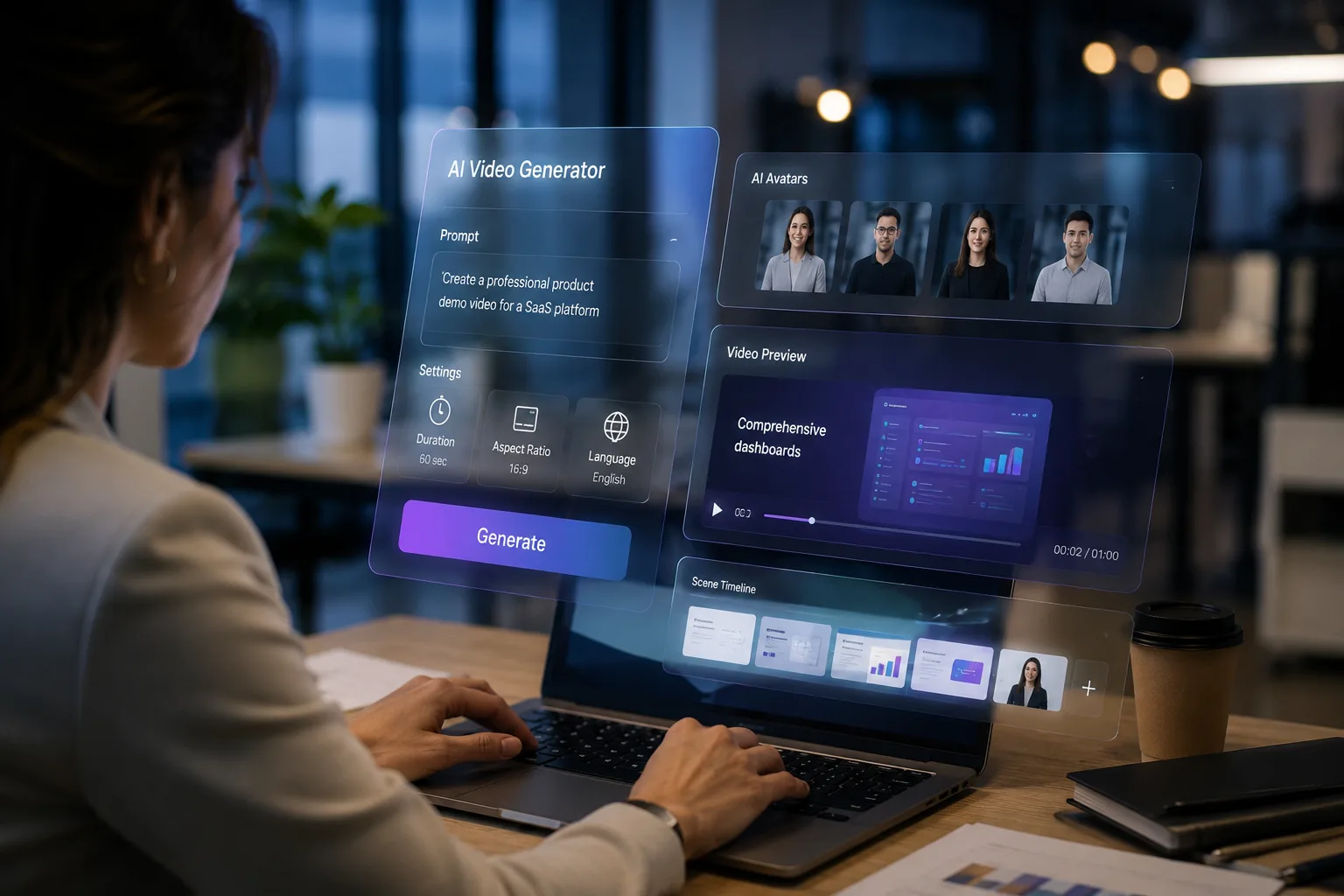

The AI applied to the company video intervenes in the generation of plans, avatars, dubbing and certain post-production tasks. It does not transform a synthetic character into a real customer and does not replace the choice of message. For B2B production, proper use depends on the content to be shown, the data used and the level of creative control required.
Still, the excitement around AI video creation often hides some background confusion. Generating a video with an AI is not the same as producing a corporate video. The tool does not replace content strategy, scripting, art direction, or thinking about brand identity.
This article presents an analytical overview of the state of art in 2026: what tools, for what uses, with what regulatory and practical limits. Without publicity for a particular tool, and without the naivety of a "top 10" joke.
An Accelerated Changing Market: AI Video Enters Companies
The market for AI video generators changed in size in 2025. Video content generated or augmented by AI is multiplying on LinkedIn, internal training platforms, prospecting campaigns. Companies’ video budgets now include an AI line next to the shooting and editing lines.
This change in pace is due to two joint factors. First, the quality of the models has progressed sufficiently so that outputs can be used in professional contexts, at least for certain formats. Second, access tariffs became accessible for non-technical teams, with offers adapted to different usage volumes.
What AI Tools Don’t Replace
The temptation is great to sum up the question to "Do AI tools replace video agencies?". That’s the wrong question. The good thing is: on what tasks does AI really bring value, and on which does it weaken the content?
What AI tools don’t do, in 2026: they don’t write a script aligned with your positioning. They do not define an artistic direction consistent with your graphic charter. They do not know that your target is an industrial SME CFO and not a fashion consumer. And they cannot validate that the message is legally correct and strategically relevant.
Script, narration, artistic direction and dissemination strategy remain non-substituable human skills. For animated formats in particular, the boundary between an acceptable AI explainer and an explainer that weakens the brand is often a matter of creative supervision, not technology. It is the territory of custom motion design, which relies on a rigorous creative brief where automatic generation stumbles on brand identity.
Le film Reemo directed by Biux presents software through an animated universe. It is shown here as a reference of graphic consistency: the choices of rhythm, composition and hierarchy of the message remain to be directed, regardless of the manufacturing tool.
AI video generation in 2026: state of the art of major platforms
The market for AI video generators today has several dozen tools. Three categories are clearly emerging for professional uses: text-to-video cinematographic generation, synthetic avatars for corporate communication, and production enrichment tools (upscaling, synthetic voice, AI stock).
Text-to-video generation: Veo 3.1, Runway Gen-4, Kling 3.0
Google Veo makes it possible to generate videos from text or images. The documentation of Veo 3.1 in the Gemini API describes the generation with audio and the sequence extension. A native generation must be distinguished from an assembly or extension: these are not the same production operations. The choice of access service also determines how data are processed.
Runway Gen-4 remains the reference for professional videographers. The Gen-4.5 version rose to the top of the Video Arena Leaderboard in 2026. The cost of use depends on the generation volume and the formula chosen. The architecture is based on NVIDIA Blackwell, resulting in a significantly improved generation speed.
Kling 3.0 (developed by Kuaishou) claims according to its publisher more than 60 million users. The model generates clips up to 15 seconds natively with simultaneous audio and video (sequential extension possible up to 3 minutes on paid subscription), and a rendering possible in 4K. Point of vigilance for the teams who consider it in a professional context: Kling is developed by a Chinese company, which raises questions about the location and governance of the processed data.
Avatars and Talking Videos: HeyGen, Synthesia
HeyGen has established itself as the reference tool for synthetic avatars and translation with lip-sync. According to its own data, the platform claims more than 100,000 user teams, and offers automatic lip synchronization in 175 languages. The enhanced API enables integration into large-scale customization workflows. HeyGen was first in the G2 AI video generator category in early 2026.
Synthesia More specifically, it targets training and internal communication. According to the publisher (Series E announcement, January 2026), more than 90% of the Fortune 100 uses it for these contexts. The platform offers more than 240 avatars, videos up to 4 hours, native LMS integration and interactive videos with navigation buttons. AI dubbing covers more than 160 languages.
These two tools meet real needs in companies: multilingual HR onboarding, in-house training in several languages without additional studio budget, large-scale personalized prospecting campaigns. Limitations remain the increasing detection of avatars by recipients, and issues of consent (see regulation section).
The Sora case: closure and lessons for the pros
La Official OpenAI documentation confirms the final closure of the Sora API on 24 September 2026. It is therefore necessary to distinguish between the end of the application and the end of API access.
OpenAI announced on March 24, 2026 the closure of Sora in two stages. Web access and application was shut down on April 26, 2026. The API will remain available until September 24, 2026, the final closing date. Source: The Decoder, 29 March 2026.
For a production team, this closure means keeping the videos, the source files and the elements needed to wind them out of the platform. Content delivered to a customer must remain usable even if the tool used during its manufacture ceases to function.
Practical instruction for any team that integrates an AI tool into its production chain is straightforward: the durability of a video AI tool is never guaranteed. Building a critical workflow around a single platform puts you at risk of operational disruption. The diversification of tools and the portability of assets are criteria of choice to weigh as well as the quality of the rendering.
Beyond Generation: Upscaling, Synthetic Voices and AI Stock
The text-to-video generation captures most of the media attention. But in everyday B2B video productions, three other categories of AI tools bring concrete and immediate value, often with fewer regulatory constraints.
Upscaling Video IA
Topaz Video AI has become the desktop reference for video upscaling. The tool mounts captures up to 8K, removes digital noise and interpolates additional images to smooth movements (up to 60 fps and beyond). It is locally installed software, which largely addresses data privacy issues.
Magnificent AI It works on image and video with a different approach: it enriches the content by creative hallucination of details, adding textures and visual information that do not exist in the source. Popular in commercial photo and video production.
Practical use: a 720p seminar capture, filmed with the means of the edge, can be reassembled in 4K for a clean broadcast on YouTube or in an institutional presentation, without re-shooting. It is a lever of valorization of an existing video heritage often under-exploited.
TTS and Synthetic Voices (ElevenLabs)
ElevenLabs It dominates the segment of speech synthesis and professional voice cloning. The tool generates natural voices in 32 languages on its main multilingual model (some advanced models cover more than 70 languages), allows cloning from one minute of audio, and exposes an API for integration into automated workflows.
Concrete use: a product video designed for the French market can be dubbed in English, German and Spanish without additional studio recording, while maintaining a convincing vocal quality. This is especially relevant for tutorials, product demonstrations or training videos for multiple markets.
A point of vigilance is necessary here: cloning the voice of a real person without his explicit consent is an offence. This dimension is discussed in detail in the regulatory section.
Video Stock Generated by AI
Adobe Firefly Video, integrated into the Adobe ecosystem (Premiere Pro, After Effects), allows you to generate short clips directly in the editing workflow. The generated content is marketable under Adobe’s terms. Pika and Midjourney Video are more artistically oriented and less suitable for strict commercial uses.
The practical interest for B2B production: enrich an editing with cutting plans generated on demand, create funds or transitions without resorting to paid stock banks, complete an incomplete capture. For animated formats or abstract sequences, these tools naturally articulate with a work of motion design when visual consistency and brand identity become requirements.
Le motion design Omi Day produced by Biux illustrates a visual direction built for a brand. This film serves as a creative reference, no demonstration of an IA generator: a plan added to the montage must be included in the visual language of the rest of the film.
What video pros need to know about limits and regulations
This is the section that almost no content on the market deals with. However, for any organization that plans to integrate AI video into its productions, it is a non-negotiable point of attention.
AI Act: transparency obligations in 2026
The AI Act (Regulation EU 2024/1689) came into force on 1 August 2024, with phased application. The bans on unacceptable risk systems took effect on February 2, 2025. GPAI (General Purpose AI) obligations, which cover large models such as those that power video generators, have been in effect since August 2, 2025.
The key date for production teams is 2 August 2026, beginning of implementation of the transparency obligations of Article 50. The European Commission guidelines separate the responsibilities of the system providers and those of the companies that use the content. This schedule should not be confused with that of other categories of AI systems.
Article 50 distinguishes between technical marking and public information. The suppliers concerned must enable the identification of the contents generated or handled by machine-readable marking. The European Code of Good Practicepublished on 10 June 2026, proposes a voluntary framework for implementing these obligations. Adherence to the code is voluntary, not respect for the law.
The company that distributes hyperstructure must inform people of its artificial nature. This does not mean that any retouching assisted by AI imposes the same visible mention: the content and use concerned must be qualified. The pre-dissemination check therefore concerns the technical provenance, the necessary information and the rights of the persons represented. Resources Public Service and Article 50 analysis complete this reading.
GDPR and personal data in AI video
The image of a person and their voice are personal data within the meaning of the GDPR. Any processing, including use in an AI generator or voice cloning, requires a legal basis and prior information from the data subject.
If the video or voice generated is that of an identifiable real person, their permission is required for the intended use, even if the final content is produced by an algorithm. The GDPR also requires informing people whose data could have been used for model training, and allowing them to exercise their rights of access, opposition and erasure. Source: CNIL, artificial intelligence
Deepfakes and Criminal Risks
The French regulations are clear and the sanctions are significant.
L’Article 226-8 of the Criminal Code includes the dissemination of a montage or algorithmic content representing a person without his or her consent, where his or her artificial character is neither obvious nor expressly indicated. The text foresees a worsening when the broadcast uses a communication service to the online public. The analysis of a real case must take into account the content, consent, presentation to the public and other possible infringements.
The AI Act adds a requirement for deepfakes to be visible to companies deploying deepfakes (Section 50(4)). Source: CNIL, hypertrucage and deepfake
Brand consistency and qualitative risks
Beyond the legal framework, the current technical limitations have direct practical implications.
Visual hallucinations remain common in 2026 even on premium models: unreadable text in generated videos, distorted hands, inconsistent objects. Time consistency is the central issue: maintaining an identical face, stable decor, and consistent brand colors across multiple layers remains an unsolved challenge for most tools.
The question of the rights on the videos generated is also to be checked tool by tool: the general conditions vary significantly on the commercial use. Some tools allow unrestricted marketing, others set limits depending on the level of subscription.
In practice: AI video is effective for cutting plans, backgrounds, simple explainers with no identifiable face, and repetitive formats. It is not reliable without human supervision for any content where the visual identity of the brand is a strong issue.
How to integrate AI into B2B video production without sacrificing quality
To decide what steps to take in a tool and what to keep in human production, consult our decision guide on corporate AI video.
The point is not to adopt or reject video AI. It is to identify precisely the tasks where it brings a net gain, and those where it introduces a risk.
Use cases where video AI is really effective
The multilingual voice-over This is probably the most mature B2B usage. A product video designed for a market can be dubbed in multiple languages via ElevenLabs or HeyGen without studio recording, with a compelling result for tutorials or demonstrations.
Personalization on a large scale via HeyGen or Synthesia is relevant for HR onboarding (each new entrant receives a personalized welcome video), internal training in several languages, or video prospecting campaigns where each recipient receives a personal message.
Prototyping and animated storyboarding allow you to validate a creative idea before committing a filming budget. It is a production use, not an end use.
Upscaling of existing captures Valuing a video heritage often underexploited: a 2022 seminar capture in 720p can become usable again in an institutional presentation or on YouTube after Topaz processing.
Cases where AI does not replace professional production
Institutional video, corporate film, customer testimonial: these formats are based on perceived authenticity and brand consistency. A synthetic avatar in a customer testimonial harms credibility. A video presenting the values of a company generated by AI without human artistic direction weakens the message.
The event capture (aftermovie of seminar, cover of salon) is not generated: it is lived and filmed. Similarly, any content that directly involves the reputation of the manager or the employer brand requires end-to-end controlled production.
For these uses, the value comes precisely from what AI cannot produce: the human presence, the authentic reaction, the staging of a real identity. To explore how AI can intelligently integrate into a B2B video content strategy without compromising on these dimensions, visit AI video productions from Biux.
Le film Accor D&TS shot by Biux shows the teams and their activity. It illustrates what a real shooting brings to a corporate film: identifiable people and a working environment that synthetic characters cannot document in their place.
Are you planning a video production combining shooting and AI tools? Describe your project in two minutesBiux returns to you with precise cost estimate.
FAQ: Frequently asked questions about AI and corporate video
Which AI to choose to generate a professional video?
It depends on the use case. For the cinematic generation, Veo 3.1 and Runway Gen-4 are the technical references in 2026. For avatars, corporate voice-over and large-scale customization, HeyGen and Synthesia are the most advanced. For integration into an existing Adobe workflow, Firefly Video is the natural entry point.
Can AI replace a video production agency?
No for content with strong brand identity (institutional, testimonial, event, employer brand). Yes, partially, for repetitive and scalable formats: multilingual in-house training, onboarding, snack content, cutting plans. Hybrid production, which combines professional filming and AI tools for certain tasks, is the most efficient approach today.
Is it legal to use AI to create videos in business?
Yes, with a review of applicable rights and obligations. Article 50 distinguishes between technical marking by suppliers and public information, in particular for hyperstructures broadcast by an undertaking. The processing of personal data requires an appropriate legal basis; rights to the image and voice must also be respected.
Is Sora still available in 2026?
The API is announced available until September 24, 2026, unlike the already closed application. The OpenAI documentation indicates that date of final cessation. For company production, keep the exports and plan to resume work in another tool; the closing schedule quoted by The Decoder should not be summed up by total unavailability as early as April.
How much does an AI video cost for a company?
The price depends on the delivery: avatar, dubbing, generated sequences and preserved shooting do not cover the same work. The Biux grid does not set a single package for all these uses. The estimate must describe the duration, languages, versions and steps supported by the team.
How long will it take for IA video production at Biux?
The IA video formats of the Biux pricing guide are delivered in 3 to 7 days. This offer includes, depending on the formula chosen, script, l’avatar or voice-over IA, montage and multilingual variations. A production that includes real filming must also integrate its preparation and organization.