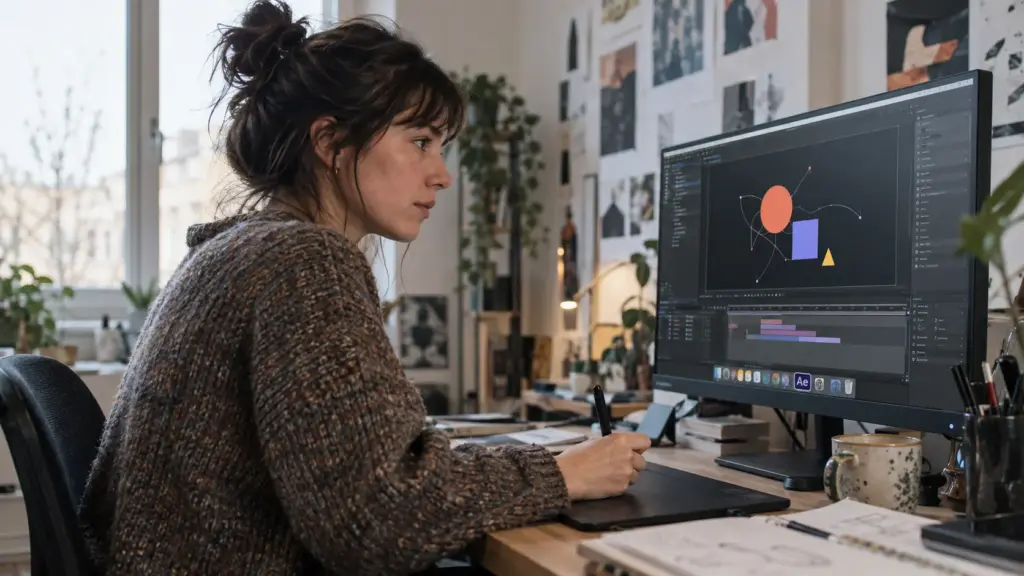

An explanatory video motion design transforms an offer, operation or technical concept into a visual narrative. It combines script, illustrations, animation and sound to guide the audience's understanding. In particular, the format is suitable for hard-to-film software and services: it allows us to show usage, prioritise information and prepare for a next commercial stage.
This is where explanatory motion design comes into play. This hybrid format, halfway between graphic animation and visual storytelling, makes it possible to translate the invisible into memorable images. We’ve been working for years with B2B companies looking to make their value understood in seconds, and we see one thing: a well-thought-out motion design video turns understanding into decision.
In this article, we explore what makes an explainer video effective in motion design, how to structure your message to convert, and what best practices to apply to make your content truly serve your business goals. Whether you are looking to clarify your offer, train your teams or convince new prospects, you will find here concrete benchmarks, from real productions and measurable results.
What an explanatory motion design video really is
Explanatory motion design is not just graphic animation. It is a format designed to solve an understanding problem, lift a brake on the purchase or clarify a value proposition. Unlike one Company presentation A classic design that shows desks and faces, motion design creates a bespoke visual universe that serves the message first and foremost.
We regularly produce explanatory videos in motion design for start-ups tech, consulting firms, software publishers. The objective is never to "do pretty", but to "make understand quickly and well". An explanatory video of 60 to 90 seconds focuses on a message that the commercial can then deepen. It makes abstract concepts land in concrete. It turns the incomprehensible into evidence.
It is a format based on three pillars: clarity of message, visual consistency and narrative fluidity. If one of the three is missing, the video becomes either pretty but empty, dense but indigestible, or flat despite a good background. The balance between these three dimensions is precisely what separates a video that maps from a video that sleeps in a Dropbox folder.
Why Motion Design Works to Explain (and Convince)
The motion design gives a visible representation to abstract information. When you explain a process only with words, your interlocutor has to build the situation mentally. An animation can show the relationships between the steps and draw its attention to the important change. The resources HubSpot on video marketing complete this reflection on the uses of the format.
For SaaS companies and tech solutions, an explanatory video shows the product in context and presents its operation in a chosen order. This is particularly true in B2B, where decision cycles are long and where each point of contact counts. Wyzowl (2025) offers data on the uses of video in marketing. A video designed to explain becomes a commercial asset reusable on LinkedIn, in email signature, on a site, in customer appointment.
Motion design also allows for full control of the pace. Unlike a video shot where framing, light and oral performance can parasitize the message, animation gives you absolute control over what the viewer sees, in what order, with what emphasis. It is a surgical format: every second serves a precise intention.
The different types of explanatory videos in motion design
Not all explanatory videos are the same. Depending on your goal, your audience and your message, you will opt for different approaches. Here are the formats we produce most often, and in which contexts they perform.
Educational motion design: clarifying a concept or process
It is the king format to explain an internal operation, a user journey, a methodology. You show step by step how things are going, with diagrams, arrows, fluid transitions. This type of video is particularly effective for SaaS, consulting firms that need to popularize their approach, or companies that sell invisible services.
We use it regularly in our tutorial and training videos to turn indigestible PowerPoint presentations into digestible and shareable video formats. The idea: simplify without infantilizing, structure without stiffening. A good instructional video in motion design gives the impression that the subject was finally obvious, while it was incomprehensible before.
Promotional Motion Design: Selling an Offer or Product
Here, the goal is no longer just to explain, but to convince. You present your solution, you show the problem it solves, you illustrate the concrete benefits. This format works very well in VSL (Video Sales Letter), on the home page of the site, or in the LinkedIn Ads campaign.
This video directed by Biux for Klyra Design puts animation at the service of the presentation of the offer. Here it illustrates how visual narration can support a commercial message, without juxtaposing a list of benefits.
We often integrate this type of content into multi-channel acquisition strategies, especially when we are working onAcquisition of qualified leads. Motion design makes it possible to create impactful visuals that capture attention in the stream, where a classic video would go unnoticed. The first second must hang, the next 15 must qualify.
Motion design brand content: embodying a vision or values
Less focused on immediate conversion, more focused on awareness and authority. You tell a story, you set a universe, you create emotion. This is the format we recommend for institutional speaking, corporate presentation videos, or branded content intended to strengthen your business. brand awareness on your distribution channels.
This type of video requires a real reflection on visual identity and storytelling. Working with an agency that masters both the artistic direction and the brand strategy becomes essential. The challenge is no longer just to make people understand, but to make them feel.
The good production practices that we systematically apply
Producing an explanatory video in motion design is not just animating shapes on software. It is first structuring a message, then finding the visual metaphors that will carry it. Here are the principles we apply to ensure results, not just deliverables.
Start with the script, always.
We never touch After Effects until we have a validated script. Because a bad script, even if animated with talent, remains a bad message. The script is the backbone of everything. It sets the rhythm, tone, key points, transitions. A good rule: 150 words maximum for 60 seconds of video. Beyond that, you lose in impact.
We often work on the script in collaboration with our customers, because no one knows their job better than them. Our role is to transform their expertise into a fluid, digestible and memorable narrative. It is also to eliminate jargon, to simplify without impoverishing, to structure without stiffening.
Create a storyboard before producing
Storyboarding is when the message becomes an image. We pose the key visual ideas, we test metaphors, we validate that the graphic universe serves the purpose well. It is also the stage where we detect inconsistencies: a great idea in writing can be illegible in image, and vice versa.
We spend time on this phase because it avoids expensive back and forth in production. A well thought out storyboard sets the intentions of each scene before the animation. The latter then brings the rhythm, transitions and precision of the movement. And that is precisely what differentiates a structured approach from a freelance that improvises.
Care for sound design as much as image
Sound contributes to the emotion and understanding of the message. A poorly recorded or misdirected voice-over can destroy the credibility of your video. Too much music can parasitize the message. A subtle sound design (sound transitions, light effects) can accompany movements and make transitions more legible.
We work with professional voiceovers, recording studios, and we take the time to direct the take to make the tone stick to your brand universe. A warm voice for a startup, a voice for a law firm, a dynamic voice for a tech scale-up: everything is in the casting and the management.
Adapting the format to broadcast platforms
A video that works on YouTube will not necessarily work on LinkedIn. The square format (1:1) makes it possible to prepare a version for LinkedIn and Instagram threads. The vertical format (9:16) is king over the stories and Reels. The landscape format (16:9) remains the standard for YouTube and websites.
We systematically produce several variations of the same video to maximize its reach and strengthen your Visibility on all platforms. It is a multi-channel production logic: a creative base, several adapted formats, optimized distribution. Because a good video that is not seen is a missed opportunity.
Specific examples and use cases that we have produced
Nothing beats real examples to understand what works. Here are some of the scenarios we encounter on a regular basis, and how we deal with them in explanatory motion design.
Example Reemo: making software understandable
To present a software solution, the scenario must link its operation to the user problem. The film Reemo allows us to comment on this work of ordering information, without assigning it a conversion rate that is not documented.
Directed by Biux for Reemo, this motion design presents a software solution in a graphic universe built for its message. The example illustrates the value of guiding the look to useful information rather than showing all screens at the same level.
Example Reaply: organize a SaaS presentation
A software presentation must show the link between the initial situation and the proposed solution. The film Reaply gives another example of animated narrative applied to a SaaS offer: the challenge is to make the journey understandable, not to multiply the effects for themselves.
The film produced by Biux for Reaply uses animation to present a SaaS offer. It illustrates the consistency to be sought between the speech, the graphic elements and their appearance on the screen.
Application: Announce a new feature
For a launch, start the useful change for the user, then show the gesture that allows you to enjoy it. The distribution format and the next expected action guide the editing. Our guide to the video for SaaS details how to articulate product presentation, demonstration and business journey.
How to choose the right approach for your project
Not all explanatory videos are the same, and not all require motion design. Sometimes, a video shot in camera with an expert talking face camera will be more relevant. Sometimes, a simple video of slides commented will suffice. The explanatory motion design is particularly suitable when:
- Your message is abstract or technical and requires clear visualization
- You sell an invisible service (SaaS, consulting, fintech, legaltech)
- You need a short, impactful, reusable format on multiple channels
- You want to create a visual universe consistent with your brand identity
- You target B2B decision makers who have little time and a lot of solicitations
If you hesitate between motion design and video shot, ask yourself this question: does my message win to be embodied by a person, or does it win to be translated into visual metaphors? If the answer leans toward the second option, motion design is probably your best ally.
For some projects, we even recommend combining the two approaches: for example, a Expert Interview enriched with motion design animations to illustrate the words. Or another customer testimonials integrated in a lively environment that strengthens credibility while boosting the format.
Paris motion design agency: why partner choice matters
Choosing a service provider for your motion design videos is not trivial. The difference between an isolated freelancer and a structured Paris motion design agency is played on several dimensions: the ability to understand your business challenges, the mastery of the entire production chain (from script to broadcast), and above all the strategic vision beyond creative execution.
Working with a motion design agency in Paris like Biux, you benefit from a 360 approach: we don’t just deliver a video, we build with you a video content strategy designed to generate results. Each project starts with a framing phase where we identify your objectives, your audience, your points of differentiation. Only then do we move on to creation.
A motion design agency in Paris that knows its job never just produces what you ask for. It challenges your brief, offers alternatives, saves you time by anticipating blockages. She knows that a successful explanatory video is a video that circulates, that converts, that becomes an asset for your company, not a one-shot that ends up forgotten.
Motion design and content strategy: thinking beyond video
The explanatory motion design never lives alone. It fits into a broader content strategy where each format plays a specific role. A motion design video can serve as a pillar to then decline short videos of personal branding, extracts for social networks, Creative ads Optimized for performance.
We always think in terms of content profitability: how a single creative base can power multiple channels, multiple formats, multiple uses. It is this approach that makes an initial investment profitable and creates a snowball effect on your visibility. A well-designed motion design video can live for months or even years, if properly activated.
This is also why we encourage our customers to work on a series logic rather than one-shot. Three explanatory videos that respond to each other will have more impact than a single isolated video. They create a coherence, a visual signature, a brand memory. They transform your communication from punctual to perennial.
Mistakes to Avoid in Explanatory Motion Design
We regularly see motion design videos that miss their target, not for lack of technical talent, but by avoidable strategic mistakes. Here are the most common pitfalls we identify during our audits or briefs.
Mistake 1: Say it all in 60 seconds
Explanatory motion design is not a catalogue. If you try to fit ten features, three testimonials, and your business history in a minute, you’re losing everyone. Better a short video with a clear message than a long video that dilutes everything.
Mistake 2: neglecting the script in favor of aesthetics
A beautifully animated video that tells anything is useless. The bottom always takes precedence over the form. The animation should serve the message, never the other way around. That’s why we put so much emphasis on the upstream scripting phase.
Mistake 3: Do not think broadcast from conception
Too many videos are created without thinking about how they will be activated. The result: an unsuitable format, too long for LinkedIn, no subtitles for silent readings, no variations for the different channels. Broadcasting should be thought of from the start, not after the fact.
Explanatory motion design, well thought out and well produced, is not a creative gadget. It’s a powerful business lever, a sustainable brand asset, and often the missing link between what you do and what your prospects understand.
It’s up to you.
How much does an explanatory video at Biux cost?
The 2D motion design includes script, storyboard, illustration, animation, voice-over and sound design. The deadline is 15 days after storyboard approval. 3D takes 3 to 5 weeks depending on the project. Do not compare the two benefits only from the final term.
Prepare the message, target, graphic resources and dissemination uses before consulting an agency. Indicate the necessary versions and validation circuit of your team. The Biux pricing guide provides the published offers; the estimate describes the deliverables of your project motion design.
Are you preparing an explanatory video for your offer? Describe your project in two minutesBiux returns to you with precise cost estimate.
FAQ
How much does an explanatory video motion design cost?
The estimate specifies deliverables, versions and production scope to compare equivalent services.
What is the deadline for an explanatory video in 2D?
Biux announces 15 days after storyboard approval for its 2D motion design offer. The project successively organizes script, storyboard, illustrations, animation and sound work. Preparing the graphic chart, the information produced and the validation interlocutors from the brief allows you to work on a stabilized message before the production of the scenes.
What does the production of an explanatory motion design include?
The 2D Biux offer includes script, storyboard, illustration, animation, voice-over and sound design. These steps link the message to its visual and audio translation. The estimate describes the versions delivered and the intended uses, especially if several formats or languages are necessary for the distribution of your video.
How long do you choose for an explanatory video?
The 60 to 90 seconds format of the 2D Biux offer is suitable for a message-centric presentation. A detailed demonstration or training may require another structure. Start from what the viewer must understand and then do; separate usages when several questions cannot be dealt with clearly together.
Do we have to show all the screens of his software?
No. Select screens that make the route useful and understandable to the target audience. A presentation video does not have the same function as a complete tutorial. Details can be developed in a separate demonstration, while the main film links the user’s problem to the concrete use of the solution.
Can we associate animation and interview in the same video?
Yes. An interview brings an incarnate speech, while animation can show a process, a data or a screen evoked by the speaker. Prepare these passages in the script to avoid a decorative illustration. Each sequence must complete what is said, while maintaining a graphic continuity and a legible rhythm for the spectator.