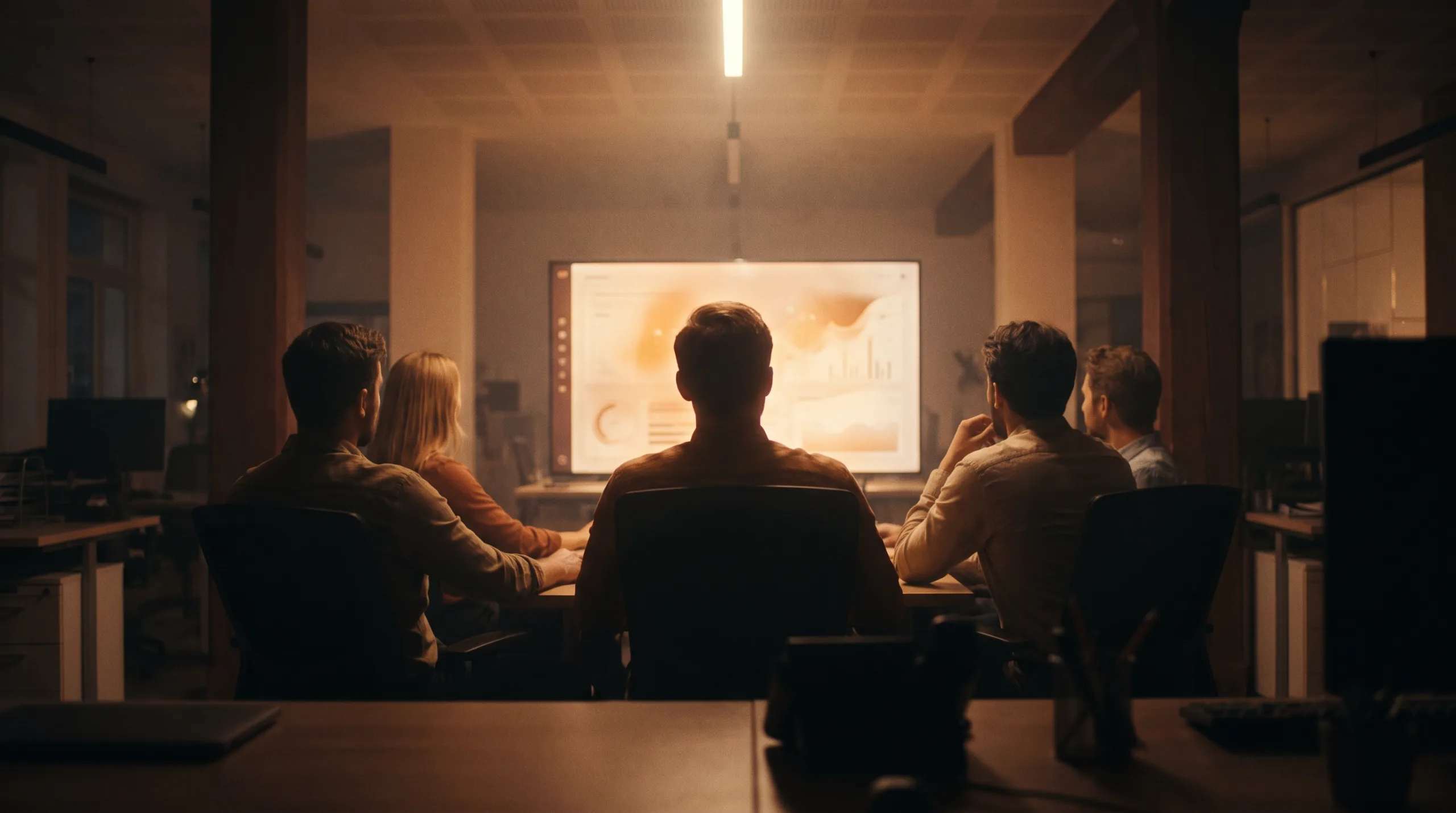

The internal communication video transmits an announcement, accompanies the integration of collaborators or explains a process to the teams already in place. Its content is prepared with the broadcast channel, accesses and viewing conditions. Onboarding, training and management message meet different needs: the format should allow recipients to understand what is changing and what they need to do.
The internal communication video meets these limits. It is addressed to employees already in office, in a logic of top-down communication: the company that transmits its messages, values and information to its teams. It’s not external employer branding, not recruitment. It is the ability to convey a message, to create meaning, to maintain the link in increasingly hybrid organizations.
This article reviews the formats that work, the channels to broadcast them and the production criteria that make the difference.
Why you should integrate video into your internal communication
A format that captures where email fails
The problem with internal email is not the bottom, it is the container. A text message requires an active reading effort that few employees agree to grant to a company communication in the middle of the day. The opening rate increases by 19% as soon as the object contains the word "video" (HubSpot, 2024). It’s no coincidence: the video is part of the habits of natural consumption, those of personal daily life.
Another often underestimated advantage is that the video guarantees a uniform message. When the DG registers an announcement, all employees hear the same, with the same tone, the same nuances. No managerial filters, no cascade "Arabic phone". Management speaks directly to the teams.
Video, a lever of commitment and meaning
Seeing a face, hearing a voice creates a level of authenticity that is impossible to achieve in writing. A leader who presents the results of the year in front of the camera produces a proximity effect that ten slides cannot reproduce. It is this human connection that nurtures the sense of belonging and strengthens the corporate culture, especially in organizations that operate in part-time telework.
Video is not a luxury reserved for CAC 40 groups. A Parisian startup of 80 people has as much interest in treating the video reception of its new employees as an ETI of 500 employees, provided that they choose the right formats and the right level of production.
The most effective internal communication video formats
The video of employee onboarding
The video onboarding concerns the integration of the employee after his arrival in the company, not the recruitment phase, which falls within the external dimension of this communication dealt with in our article on the Video of Recruitment. This format is for the employee who has just signed, who discovers his colleagues, his tools, his cultural references.
An effective onboarding video generally covers the company’s values, a presentation of key teams and trades, internal tools and processes, and some practical benchmarks (regulations, spaces, uses). The ideal time is between 3 and 5 minutes, alternating speeches: a founder, a HR manager, colleagues from the same department.
The challenge is real: according to a Brandon Hall Group study from 2022, structured onboarding improves employee retention by 82%. And 22% of the total turnover occurs within the first 45 days after hiring. A professional, clear and warm video on arrival sends a strong signal on the quality of the organization.
To prepare a series of onboarding, separate the company’s presentation, working methods and practical benchmarks. Each module answers a question from the new arrival. Evaluate its usefulness from team feedback, without assigning an encrypted result to an undocumented client case.
To deepen the post-integration training component, videos of the type tutorial or internal training This is a natural extension of this onboarding.
The announcement of direction
The presentation of the annual results, the announcement of a reorganization, the communication of a strategic direction: these are moments when the quality of the message is directly proportional to the quality of the format. A president or a CEO facing camera, with a clean sound, a controlled light and elements of motion design to illustrate the key figures, it is a communication that inspires confidence and seriousness.
Recommended format: 3 to 4 minutes, direct and human tone, graphic animation for encrypted data. The difference between an ad filmed on Teams with a built-in microphone and a professional production is immediately noticeable to employees. It says something about how the company views itself.
Le merger film Next Mobiles x Mobile Club directed by Biux accompanying a change in the lives of companies. It illustrates the need for an understandable narrative during a transformation, without presuming the internal channel on which each organization has spread.
The video of valorization of teams and projects
A digital transformation project, a strategic partnership, the launch of a new product: these projects mobilize teams for months, often in silos. An internal reporting video, with field interviews and behind-the-scenes footage, serves several purposes at the same time: thanking contributors, explaining the project to other teams, and reinforcing pride in belonging.
This format also creates transversality: who does what in the company, how the different services interact, what skills are mobilized. It is a way of making visible the invisible of daily work.
Un Collaborator portrait distributed internally, for example, can start from a specific project and tell the story of the person who carried it. This hybrid format serves both the valorization of the teams and the strengthening of the corporate culture.
Le Accor D&TS film produced by Biux presents an organization through its teams and activities. It shows how an incarnate presentation can serve as a visual reference to a communication project for collaborators.
The training and process capsule
Internal procedures, safety rules, regulatory compliance, a new business tool: these contents are often presented in the form of PDF manuals or slides that no one really reads. The internal training video is a game changer.
The e-learning studies converge on one observation: the completion rate of video modules far exceeds that of text or equivalent slides. A 2- to 3-minute module, accessible from the intranet or digital workplace, effectively replaces a 15-page document. And unlike a face-to-face session, it is available 24 hours a day and can be consulted when the employee needs it.
The tutorial or internal training videos de Biux are structured by module, with systematic subtitles and divided by pedagogical objective.
The internal event video
An annual seminar, a sales agreement, a team building: these highlights generate energy that can be extended well beyond the day itself. A Aftermovie Seminar well realized, broadcast internally in the following days, allows those who were not present to take ownership of the event and participants to relive the highlights.
A pre-event teaser, broadcast a few days before, can also increase team engagement and involvement even before the event begins.
Le motion design Omi Day directed by Biux gives an example of animated graphics. It illustrates a way to format an event message, distinct from the capture of speeches or reporting on participants.
Channels to stream your internal videos
Producing a quality internal video is not enough if it does not reach its recipients. Multichannel delivery is a condition of efficiency, and it’s a point that few organizations are working on enough.
Here are the main channels to combine according to your organization:
- Intranet and digital workplace (SharePoint, Jalios): the natural repository where video remains accessible in the long term and can be found by all.
- Internal newsletter with clickable thumbnail : avoid the direct integration of the player into corporate mail clients (limited compatibility). Prefer a cover image that links to the hosting.
- Channels Teams or Slack : fast delivery, possible reaction, ideal for short ads or teasers.
- Screens in the premises (lobby, cafeteria, open space): reach employees who did not expect it, without active effort on their part.
- Briefing manager : the video as a support that managers relay in a team meeting, with a context and a time of exchange.
Choose the channels actually used by your teams and check the accesses before sending. A field employee and an office employee do not always have the same viewing conditions. Workplace is no longer a broadcasting option: Meta indicates closure in May 2026.
Two technical constraints to anticipate: a significant proportion of videos are viewed on mobile, and the majority of videos on social networks and internal platforms are watched without sound. Subtitles are not a comfort option, they are a condition of understanding.
What makes a good internal video
Authenticity rather than smooth corporate
Internal video doesn’t have to be perfect. She needs to be true. Direct tone, recognizable faces, natural speech: collaborators immediately recognize when a message is sincere or recited. The common mistake is to confuse "production quality" and "cold corporate". A good production is a clean sound, a stable framing and a controlled light, without requiring a studio decor or a prompter.
This is precisely what Biux is working on: cinema quality at the service of authentic speech, without sacrificing one for the other.
To work on this incarnation, our guide explains how humanising the company’s communication through video, from people and their actual activity.
The duration adapted to the format
The duration of an internal video is not an arbitrary constraint, it is a signal sent to the employee on the effort that is requested. The recommendations resulting from the sector benchmarks 2024-2025 converge towards consistent durations according to the format:
- Short announcements, teasers, messages direction: 1 to 2 minutes
- Annual results, strategic presentation: 3 to 4 minutes
- Onboarding, training capsules: up to 7 minutes per module
Beyond 3 minutes, the grip of the first 10 seconds becomes decisive. If the employee does not immediately understand why this video concerns him, he moves on.
Sound, often overlooked variable
Sound is the first factor in abandoning a video. A smartphone microphone in a noisy open space, an untreated conference room reverb, a parasitic background: these problems are immediately identified as a lack of care. Investing in a quality audio recording is the first ROI of an internal video production, even before the image.
The subtitles complete this acoustic requirement: accessibility for employees with disabilities, comfort for those who watch without sound, and guaranteed understanding regardless of the employee’s mother tongue.
Entrust your internal communication to an agency or manage internally?
This is a question that communication departments and HRDs ask on a regular basis. The answer is not binary.
When the smartphone is enough : Participatory and informal formats, such as spontaneous testimony, a team event summary or a message of congratulations, sometimes gain in sincerity when they are not over-products. A team building video filmed by the participants themselves can create more link than an aftermovie too licked.
When to entrust to a production agency As soon as the video represents the image of the company in the broad sense, for example a management announcement, an official onboarding, a presentation of the results or a training capsule integrated into the HR path. Sound and visual quality become a criterion of authority. A production sloppy on a strategic message undermines the credibility of the message itself.
The decision criteria:
- Hearing : the whole company or a small team?
- Issue : Engage and convince, or inform quickly?
- Frequency : one-off production or regular series with a consistent charter?
Biux works with Parisian SMEs and ETIs who need to professionalize the "official" layer of their internal communication, without necessarily outsourcing the whole. A production partnership can focus on strategic announcements, onboarding and priority training capsules, while internal teams manage daily formats.
The internal communication video also extends your Employer Brand Strategy : the values you transmit internally are the same as those you show externally. Consistency between these two levels enhances the credibility of the whole.
A project related to the company’s commitments also requires specific evidence: our article on the CSR video helps prepare this message. To present the organization to its teams, the corporate film is a separate format for a training module.
Internal video formats: what to remember
Internal communication video is not a large group investment. It is an accessible lever for any company that wants its messages to be truly received, understood and retained by its teams. Email and PowerPoint don’t go away, but they’re no longer enough to make sense in hybrid, ever-moving organizations.
The formats cited, whether onboarding, management announcements, project valorisation, training or aftermovie, have in common to be thought of for the recipient, not for the issuer. Multichannel broadcasting, mobile first and systematic subtitles are not technical details: they condition the actual viewing rate.
To go further on the recruitment axis and attract talent, our article dedicated to the Employer Brand Video details the candidate-oriented formats. And if you work on the individual valuation of your teams, employee profiles are a powerful format for combining internal communication and pride of belonging.
FAQ
How much does an internal communication video at Biux cost?
The price depends on the format. First define the message, recipients and deliverables. A presentation film and an educational series do not correspond to the same production scope.
What is the time frame for producing an internal video?
the Biux pricing guide provides 15 days after filming for a corporate film and 15 days after filming for a tutorial or training module. The preparation includes the briefing, stakeholders, and access to the site or tools. Plan an interlocutor who centralizes returns, so that validations follow the schedule set out in the estimate.
What does a Biux training video module include?
The published scope includes educational cutting, screencast or shooting, voice-over, subtitles and an MP4 file for the LMS. Define the learning objectives and the information to show. Accommodation, employee access and pedagogical follow-up should be arranged separately when they are not included in the estimate.
Should we broadcast an internal video on YouTube?
Not necessarily. Choose hosting that is compatible with the confidentiality of content and employees’ access. Check permissions, sharing, and playback on devices used before broadcast. An internal video can be relayed by the intranet or a work tool already adopted, without making the message accessible to the public.
What difference between video onboarding and recruitment video?
After his arrival, he accompanies an employee, including reference points, tools, methods and people to know. The recruitment video is intended for candidates and presents the trades or work environment. Images may be common, but the message and the practical information must correspond to the recipient and when he or she consults them.
How to measure the usefulness of an internal communication video?
Check first that recipients have access to the content, then watch the viewings and collect their questions. For training, add an exercise or a feedback on the explained procedure. For an announcement, check the understanding of change. The number of views alone does not make it possible to conclude that the message was understood or applied.
Do you want to structure your internal video communication with a production partner based in Paris? Request a quote Biux. The grid indicates 15 days after filming for a corporate film and 15 days after filming for a training module.