
A business video is chosen according to its purpose: to present an activity, to convince a prospect, to recruit or to train. The corporate film gives an overview, the testimony provides evidence and the motion design explains a complex subject. For SMEs, ETIs and B2B startups, the target audience and the broadcast channel direct the format prior to shooting.
However, in SMEs and B2B startups, the question often remains unanswered: we think first of the format ("we would like a corporate video") before clarifying the objective ("to do what, to whom, on which channel?"). This lag explains why many corporate videos do not perform.
This article adopts the opposite logic: starting from the business objective to identify the appropriate format.
Why video has become essential in B2B communication
A format that improves memorization and engagement
Video is not a fad. It responds to a real constraint in professional environments: attention is rare, fragmented, and decision-makers are over-solicited.
The numbers speak for themselves. 93% of marketers surveyed Wyzowl, video improves the understanding of products or services by users. 85% report that the video directly contributed to increasing their leads.
It’s not just a matter of attention. The video condenses in 90 seconds what a 10-page PDF struggles to communicate: the tone, culture, personality of an organization. For a sales manager, HRD or B2B-targeted founder, this information density is decisive.
Video at the heart of the B2B buying journey
The video takes place at all stages of the B2B buying journey, from the initial discovery to the final decision. A prospect who stumbles upon a well-built corporate film on the site of a potential supplier does not leave with a list of features: he leaves with an impression, a confidence, a feeling of recognition.
Similarly, a video customer testimonial consulted before a commercial call reduces friction. An explanatory motion design embedded in a nurturing email maintains the commitment between two appointments. Video communication is not a icing on the cake: it structures the course.
This is precisely why the Marketing Statistics Report by HubSpot Ranks short video among the highest ROI content formats in 2026, ahead of blog posts and static content.
Video formats according to your business objective
A video format is not an aesthetic choice. It is a tool serving a specific objective, addressed to a defined audience, broadcast on an adapted channel. Here is how to distinguish the main formats according to the business purpose.
Strengthen your reputation and your brand image
Main format: corporate or institutional film
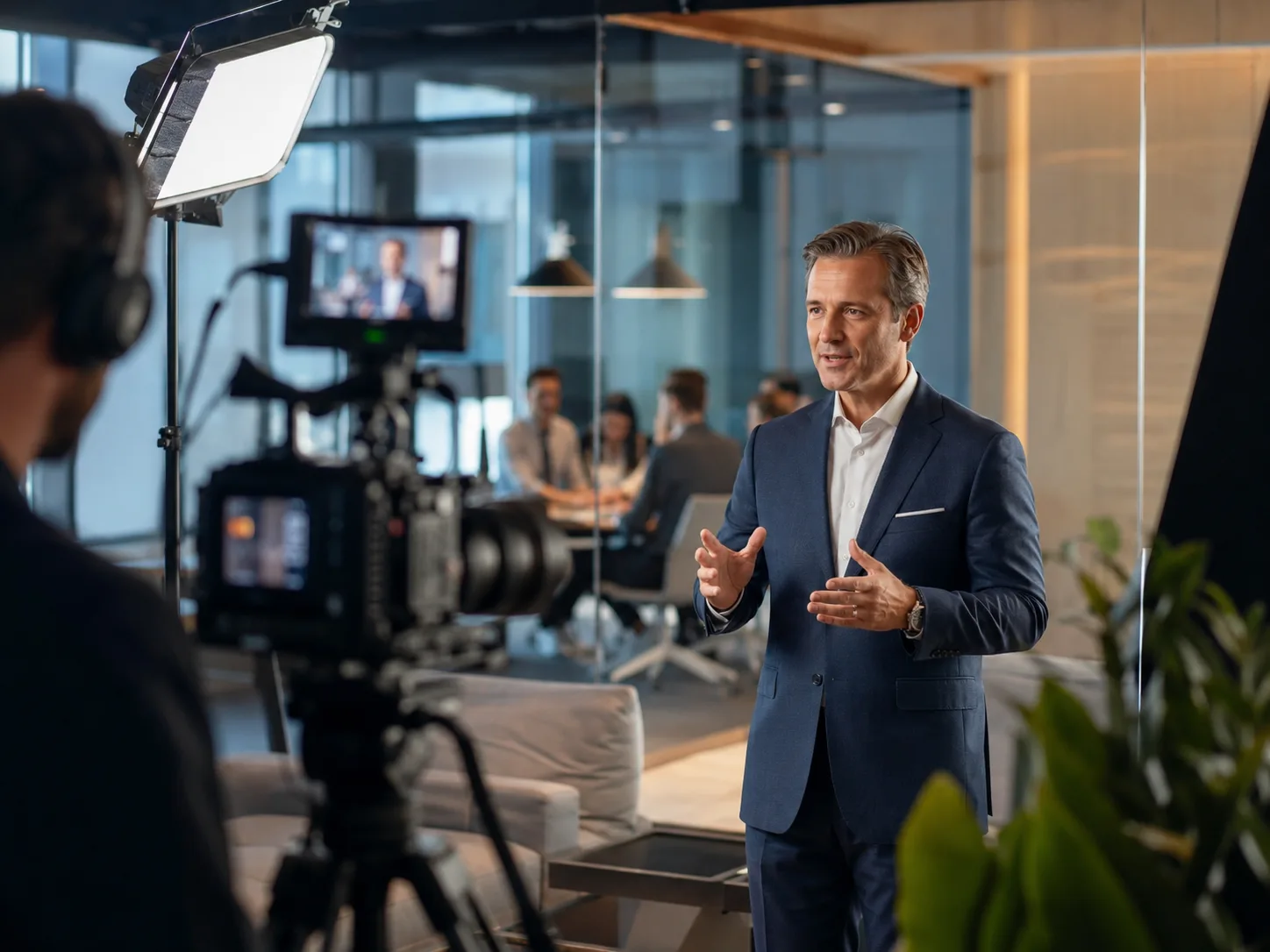
This is the most versatile format for video communication in B2B. It presents the company’s values, teams and positioning in a narrative register. Typical time: 2 to 4 minutes. Ton: storytelling, incarnation, vision.
A specialized consulting firm, an industrial mid-sized company or a SaaS scale-up use it in the same way: establish their identity before starting a commercial conversation. On LinkedIn, in a pitch deck or on the homepage, the corporate film is often the first contact between a B2B brand and its future customer.
His strong point: he serves for a long time. A well-produced corporate film remains relevant 2 to 3 years. This is evergreen content with high perceived value.
Le film Accor D&TS directed by Biux presents the activity and the teams through a corporate narrative. It illustrates the role of this format: giving a face to the organisation and making its positioning understandable before a commercial exchange.
Convert and generate leads
Main formats: customer testimonial, VSL, product video
When the target is commercial, the format changes. We are no longer trying to establish an identity, but to trigger an action.
Le customer testimonial video is the most effective social proof tool in B2B. A real customer who explains in 90 seconds why he chose you and what it brought him concretely is worth ten pages of brochure. This format is particularly formidable in landing page or commercial closing.
La Video Sales Letter (VSL) is a long-form version, 5 to 15 minutes, which follows a video copywriting structure: problem, solution, proof, call to action. It operates at the top of an acquisition tunnel, in a LinkedIn sponsored campaign or on a capture page, for complex offers where the purchase act requires a thorough conviction.
The product video and tutorial covers demonstration use cases: showing the product in action, explaining a feature, answering objections before the sales call.
Target time for these formats: 60 seconds to 2 minutes for the testimonial, 2 to 15 minutes for the VSL depending on the complexity of the offer. Main channel: landing page, email B2B, sponsored LinkedIn.
Attract and retain talent
Main Format: Employer Brand Video
Recruitment has become a communication issue in its own right. Qualified candidates compare employers with the same rigor as B2B buyers compare suppliers.
La Employer branding video respond to that expectation. It takes various forms: collaborator portrait (2 minutes, authentic tone, open questions), immersion in the offices (reporting format, dynamic editing), seminar aftermovie (2 to 4 minutes, collective energy, feeling of belonging).
What works in this format: authenticity. A HRD who speaks to the camera with his words, a team who laughs in the meeting room, imperfect but real premises. Overproduction is here. What the target is looking for is proof that real people are working behind the brand.
Main channel: Careers page, LinkedIn, enriched job offers. Duration: 1 to 3 minutes.
Train, onboard and communicate internally
Main formats: motion design, tuto, video onboarding
The video is not reserved for the outside world. Internally, it reduces training time, standardizes messages and frees managers from repetitive briefings.
Le Motion Design Explained is particularly suitable for popularizing a complex process, presenting a new HR policy or explaining a business tool. Graphic animation shows what you can’t film: a data stream, a system architecture, an accounting rule.
The video tutorial (screen recording commented or shooting in real conditions) covers the use cases of product training, onboarding new collaborators, visual documentation of procedures.
Typical duration: 2 to 5 minutes, divided into chapters to facilitate navigation. Channel: LMS, intranet, internal email.
Le motion design Predilis produced by Biux presents software for the health sector. The animation allows you to follow the uses and information of the interface, a useful approach to presenting a tool or accompanying its grip.
Cover and enhance your events
Main formats: aftermovie, conference capture
A seminar, a trade show or a client conference generates emotion in the moment, but this emotion disappears in a few days if it is not captured.
Aftermovie transforms this event into sustainable content. 2 to 4 minutes, rhythmic editing, adapted soundtrack: the result serves as both proof of legitimacy (we do events of this scale), post-event LinkedIn content, and reference for future editions.
Conference or roundtable capture is complementary: it allows to recycle the speeches of experts in thought leadership content broadcast on YouTube or LinkedIn.
Main channel: LinkedIn within 48 hours post-event, customer newsletter, website in the News section.
Format, objective, channel: the reference table
| Objective | Recommended format | Target duration | Main Channel |
|---|---|---|---|
| brand awareness / brand image | Corporate film | 2-4 min | Website, LinkedIn, pitch deck |
| Conversion / lead generation | Customer testimonial, VSL | 1-2 min / 5-15 min | Landing page, email B2B, LinkedIn Ads |
| Recruitment and employer brand | Video employer brand, employee portrait | 1-3 min | Careers, LinkedIn, jobboards |
| Training and internal communication | Motion design, tutorial, onboarding | 2-5 min | LMS, intranet, internal email |
| Events | Aftermovie, capture | 2-4 min | LinkedIn, newsletter, website |
| Social Media / Snack Content | Short formats, adaptations | 15-90 sec | LinkedIn, Instagram, YouTube Shorts |
This table is a starting point, not an absolute rule. A corporate movie can very well serve a LinkedIn Ads page if the targeting is good. A VSL can be integrated into a cold prospecting email. The logic remains the same: the objective dictates the format, the channel confirms the constraints of duration and tone.
How to choose the right format for your business
Starting from the goal, not the format
The most common error: start with "you want to make a presentation video" without having defined what this video should produce as a result.
The right approach: starting with a measurable goal. Generate X demo requests in 3 months on LinkedIn? Customer testimonial or VSL is more suitable than a long corporate film. Reduce churn rate by improving onboarding? The video tutorial is more relevant than an aftermovie.
The method: measurable goal, defined audience, confirmed channel, then format. In that order.
Le Reply x Ayming testimony shot by Biux gives the client the floor to present his/her collaboration. This example shows why a commercial reinsurance objective calls for incarnated evidence rather than just a presentation speech by the claimant.
Criteria that guide the choice
Four variables systematically come into play:
The planned broadcast channel. A video intended for LinkedIn (square or vertical format, subtitled, silent-first) does not occur as a video intended for a pitch deck or a website. The broadcast format determines the production format.
The lifetime of the content. A corporate film is an evergreen investment: it remains relevant 2 to 3 years if the values and the team do not change radically. An aftermovie or campaign video has a shorter lifespan. This criterion influences the budget allocated and the level of finish expected.
The target. Cold prospect who discovers your brand, existing customer to retain, potential candidate, employee in onboarding: each has a different level of knowledge, a different expectation, and responds to different formats.
The stage of the journey. At the top of the funnel, we work notoriety and memorization with a corporate film or LinkedIn content snack. In the middle of funnel, social evidence is activated with a client testimony or video case study. At the bottom of the funnel, we convince and convert with a VSL or a product demo.
Internalize or outsource production?
The issue comes up regularly in SME marketing and communication teams. Smartphone shooting, editing on online tools, minimum budget: it’s feasible for authentic content snack on networks. But for high-value formats such as corporate film, customer testimonial or motion design, the quality delta between internal production and professional production is immediately visible.
What internal production cannot reproduce without heavy hardware investment: the complete control (framing, lighting, direct sound, prompter), professional editing and color colour grading, animated motion design, the sound engineer in post-production.
Outsourcing is also a matter of business time. A marketing team that spends 3 weeks coordinating amateur filming produces less value than if it focuses on broadcasting and strategy while a specialized team manages production from A to Z. For a corporate film Biux, delivery takes place 15 days after the filming. The production scope defines the versions to be reused on your different channels.
Are you planning a video for your company? Describe your project in two minutesBiux returns to you with precise cost estimate.
Identify the formats adapted to your objectives
Corporate video is most effective when it is thought of as a strategic tool, not as one-time communication content. Each format has a precise function, a natural audience and specific production constraints.
What changes it to B2B: aligning the video format with a measurable business objective, choosing the channel before deciding on the duration, and entrusting the production to a team that controls the entire chain, from pre-production to final rendering.
FAQ
Which video format to choose to present a company?
The corporate film presents activity, teams and positioning. It is suitable for a home page, a business appointment or a presentation of the organization. To explain only a product or feature, demonstration or motion design responds more directly to the audience’s need.
How much does a corporate video cost at Biux?
The corporate film, customer testimonial and motion design have different scope, detailed in the Biux rate grid.
What is the deadline for a corporate film?
Biux delivers a corporate film 15 days after filming. The preparation takes place upstream: definition of the message, identification of places, selection of persons filmed and organization of interviews. The schedule must therefore distinguish the preparation, the date of shooting and the delivery of the planned versions.
What does the production of a corporate video include?
The scope is defined by the deliverables of the estimate: preparation, shooting or animation, editing and distribution versions. For a corporate film, interviews and illustration plans build the story. Subtitles, social formats, languages and operating rights must be included in this area so that everyone knows what will be delivered.
Can we use the same video on multiple channels?
Yes, if production provides for the necessary variations. A version for the site can become the source of extracts for LinkedIn, a sequence for a commercial appointment, or a vertical format. The scoping, readability of texts and subtitles must be thought of for these purposes from the time of preparation.
Should a director or collaborator be filmed?
The choice depends on the message to be transmitted. The executive can carry the vision, employees show the trades and a customer explain the benefits of a collaboration. Choose the people who can bring concrete information and prepare their subjects without imposing a speech on them that they would not naturally say.
To go further and identify the most suitable formats for your situation, consult our page dedicated to corporate video.