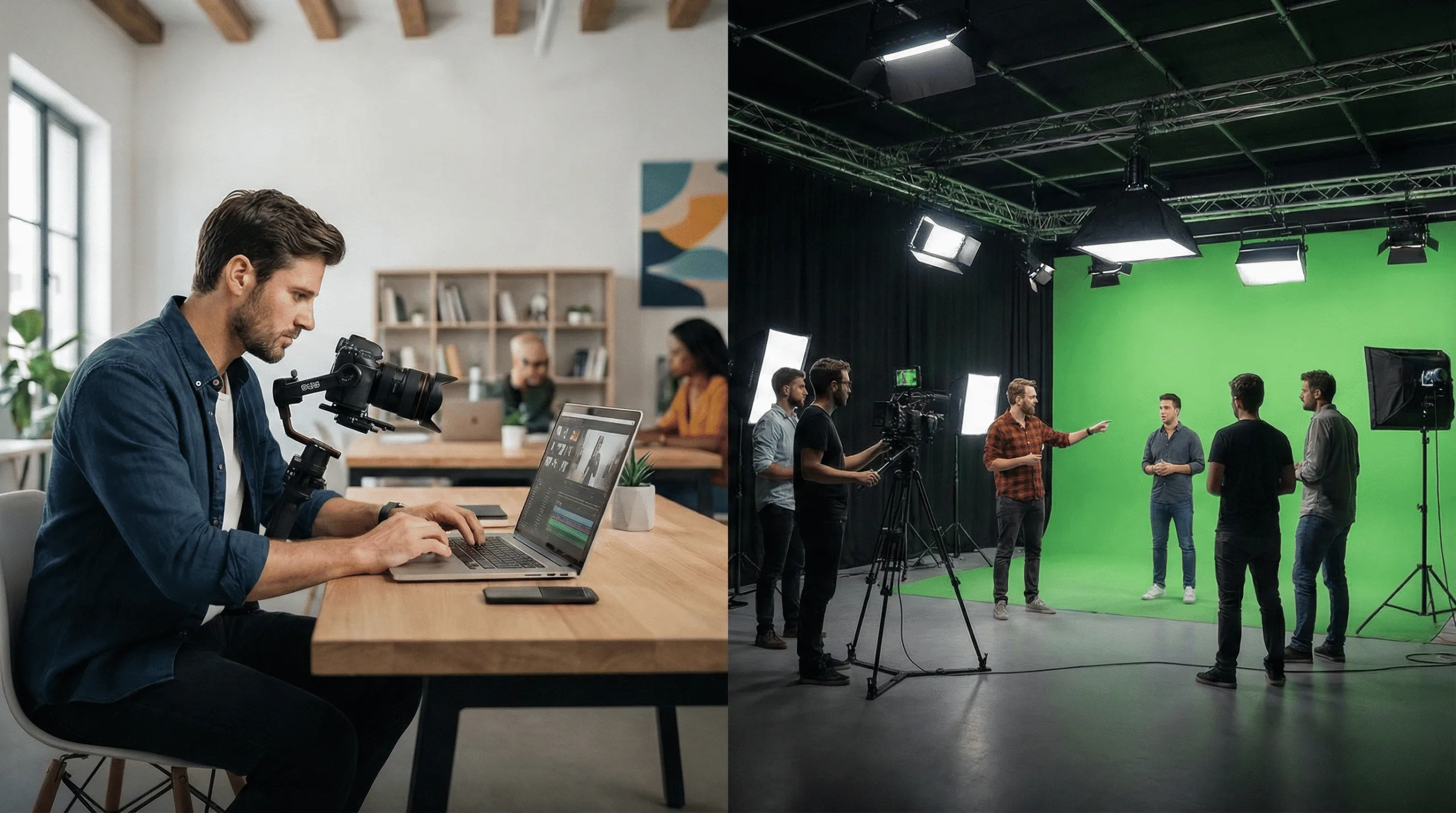

Video or freelance agency: the right choice depends on the skills required, the volume of production and the control that your team can take care of. Compare the quotes on the same scope, from the brief to the delivered files. An independent interlocutor and an agency do not always organize responsibilities in the same way; check the means actually provided for your project.
At Biux, we have been supporting B2B companies for years in their video strategy. We know the advantages and limitations of both options. We also know that there is no universal answer: it all depends on your context, your ambitions and your internal organization. What we can do is share our experience in the field to help you make a clear decision.
The real issues behind this choice
Before comparing freelance and video agency, let’s lay the groundwork. When you’re looking to produce videos for your business, you’re not just looking for someone who’s filming and editing. You’re looking for someone who understands your business issues, knows how to translate your message into visual storytelling, and delivers content that performs.
Because a video is not just a deliverable. It is an acquisition lever, a tool of credibility, an accelerator of brand awareness. Wyzowl (2025) 87% of marketers say video has a direct positive impact on their sales. Whether for LinkedIn, YouTube, your website or your advertising campaigns, each video must have a clear and measurable goal.
The problem is that many companies fall into the trap of "beautiful video". You know, these licked, aesthetic content, but that doesn’t produce any concrete results. We don’t play that game. A video that doesn’t convert, that doesn’t strengthen your authority or that doesn’t generate commitment is a missed investment.
So when you hesitate between freelance and video agency in Paris (or elsewhere), the real question to ask yourself is: what do I really need to achieve my goals?
Freelance video: when it works (and when it gets stuck)
Let’s start with freelance. The main advantage is obvious: the cost. A video freelancer is usually cheaper than a video agency. If your need is punctual, simple and well framed, it is often a relevant solution.
Situations where the freelancer works:
- You already have a clear video strategy and you’re just looking for a pair of hands to run it
- Your need is very targeted: a simple shooting, a specific editing, an isolated motion design animation
- You have the time and resources internally to pilot, brief and restart
- You are not aiming for regular or industrialised production of content
Where it gets complicated is when you need more. Because a freelancer, no matter how talented, stays alone. And professional video production is rarely a one-man show. There is strategy, storytelling, filming, editing, sound design, the Motion Design, multichannel broadcasting. Asking just one person is risky.
The Limits of Freelance:
- Limited versatility : few freelancers excel in strategy, filming, editing and motion design
- Fluctuating availability : a good freelancer is often booked, which can lengthen your deadlines
- No back-up : if he is sick, on vacation or on another project, you are blocked
- Project management on you : it is up to you to coordinate, relaunch, validate each step
In other words, if you are looking to regularly produce high-performance videos, with a constant level of quality and a real strategy behind them, the freelancer risks showing his limits quite quickly.
The video agency: what you really gain
Now on to the video agency. Yes, it is more expensive. Let’s look at what you actually buy. In fact, if you ask yourself specifically How much does a corporate video cost?All the factors that influence the budget have been dissected.
When you work with a video agency like Biux, you’re not just paying for a technical service. You invest in a complete team, transversal expertise and strategic support from A to Z.
To give you a concrete example of what a video agency can produce, here is a corporate video we made for Storm Reply:
Le Storm Reply film produced by Biux presents a technological enterprise. It illustrates the result of preparation, filming and editing work, the responsibilities of which must be identified in the claimant’s estimate.
Here’s what a video agency gives you:
A multidisciplinary team at your service
No more one-man shows. You have access to complementary profiles: strategist, director, cameraman, editor, motion designer, sound designer. Everyone does what they do best. The result? More accomplished, more impactful, more professional videos.
A fluid and structured project management
You do not have to manage 15 interlocutors or restart to know where your project is. The video agency takes care of everything: planning, coordination, monitoring, delivery. You save time, energy and serenity.
A strategic approach first and foremost
We don’t just execute your brief. We’re helping you build it. Ask the right questions: What is the goal? What target? What message? What diffusion? A good video agency always starts with strategy, not the camera.
Industrialized production capacity
Need to produce 10 videos of personal branding A month for LinkedIn? To create a series of explanatory videos in motion design ? To turn several Interviews the same day? A video agency has the structure, resources and processes to scale your production without losing quality.
A guarantee of continuity and reliability
No risk of ghosting, unexpected delays or missed deliverables. A video agency engages its reputation on every project. You have the assurance of a stable, responsive and professional interlocutor.
Video agency in Paris: why proximity matters
If you are based in Paris or Île-de-France, working with a Parisian video agency makes sense. Not just for the ease of logistics (even if it helps), but especially for the responsiveness and understanding of your ecosystem.
The advantages of a Paris video agency:
- Easier turning fast travel, smooth location, access to the best spots and studios
- See you in person : nothing replaces a strategic workshop or a creative brief face-to-face
- Knowledge of the local market : understand the codes, expectations and specificities of Parisian companies
- Partner Network : access to actors, studios, quality technical service providers
At Biux, we are based in Paris and work mainly with B2B companies in the region. We know the challenges of our customers: tech startups in fundraising, consulting firms who want to assert their expertise, companies who want to humanize their communication. This proximity allows us to be more relevant, more responsive and more aligned with their issues.
Of course, we also support customers in the region or internationally. But when you’re looking for a video agency in Paris, you’re also looking for that local dimension that facilitates collaboration and builds trust. If you are wondering about the different options in France, we have detailed the landscape of studios and video agencies.
To clarify what you expect from the claimant, our comparison between production box and video agency details the responsibilities, deliverables and selection criteria.
Comparison table: freelance vs video agency
To help you see more clearly, here is a summary table that compares the two options on the criteria that really matter:
| Criterion | Freelance Video | Video Agency |
|---|---|---|
| Cost | Cheaper in the short term | Higher investment, better ROI |
| Polyvalence | Limited to 1-2 skills | Complete and complementary team |
| Availability | Variable according to schedule | Guarantee of continuity |
| Strategy | At your expense | Strategic support included |
| Volume of production | Low to medium | High and industrializable |
| Project Management | About you | Full support |
| Quality | Depends on the profile | Guaranteed professional standard |
| Reactivity | Variable | Structured and responsive process |
| Long-term monitoring | Difficult to maintain | Long-term and evolving relationship |
To illustrate the difference between a simple video and a strategic video designed to convert, here is a VSL we created:
La VSL 5000.dev made by Biux organises the presentation of an offer in a sales format. This example shows why the claimant’s choice must take into account writing and the commercial objective, beyond the mere taking of views.
How to decide for your company
Now that you have all the elements, how to choose concretely? Here is our method to help you decide.
Ask yourself these questions:
- What is your level of video maturity? If you’re just starting out with a test project, a freelancer may be enough. If video becomes a pillar of your marketing strategy, the agency is a must.
- What production volume are you aiming for? A Corporate Video by quarter? A freelancer does the trick. Several videos per month to feed your social networks? You need a structured video agency.
- Do you have the resources to drive in-house? If you have a marketing or communication manager available to manage the project, a freelancer is possible. Otherwise, delegate to an agency that takes care of everything.
- What level of quality do you require? For strategic corporate content, institutional videos or VSL who need to convert, do not skimp: go through a video agency.
- Are you looking for responsiveness and proximity? If you are in Paris and you want a local, responsive and available partner, a Parisian video agency will be more suitable than an overwhelmed freelancer.
At Biux, we regularly receive companies that first tried the freelance adventure. Often, they realize that they are wasting time, that the quality is uneven and that managing it all internally exhausts them. They come back to us not because freelancers were bad, but because they need more: more structure, more strategy, more results.
Moreover, to better understand Different types of B2B videos that you may need to produce, we have created a comprehensive guide that will help you identify your priorities.
Investing in the right video solution
The choice between video agency and freelance is not a matter of right or wrong. It is a question of matching your needs, your organization and your ambitions.
If you are looking for a one-time solution, at a lower cost and you have the shoulders to fly, the freelancer can do the trick. But if you want to structure your video communication, regularly produce high-performance content and rely on a complete team that understands your business challenges, then a Paris video agency like Biux will be your best ally.
We don’t make videos to make videos. We create content that generates Visibilitycredibility and concrete results. HubSpot B2B companies that post videos regularly generate 41% more web traffic than those that don’t. Because at the end of the day, what matters is not having a great video. It is to have a video that brings you back.
Do you compare the solutions for your video production? Describe your project in two minutesBiux returns to you with precise cost estimate.
FAQ
How much does a corporate movie with Biux cost?
A presentation film corresponds to a specific scope, not all video performances. To compare an agency with a freelance, ask for the same scope: preparation, shooting team, editing, graphics, returns and final files. Tariff alone does not describe the responsibilities entrusted.
What is the deadline for a corporate video?
Biux plans 15 days after filming for a corporate film. The preparation takes place prior to the shootings: briefing, speakers, locations and planning. When comparing, ask each provider to distinguish between these steps and the necessary validations; an announced deadline without a specific starting point does not allow comparison of proposals.
What should a video provider’s quote include?
The estimate must describe the deliverables and the means of producing them: preparation, shooting, editing, sound, graphics and versions. Also check returns, user fees and the person who controls validations. The strategy or dissemination is not automatically included in each offer; they must be identified within the scope ordered.
When to choose a video freelance?
Freelance is appropriate to a need where skills, deliverables and piloting are clearly defined. Examine his references on the desired format, availability and collaborators he can mobilize. Your team needs to know what they are responsible for, including the briefing, stakeholder coordination and content validation.
When to choose a video agency?
An agency is adapted when the project requires several trades and coordination that you wish to delegate. Check out who actually does writing, directing, editing and tracking. Ask for examples comparable to your need; agency status does not replace examination of its productions or a clear contractual scope.
Can we work with an agency while keeping the strategy internally?
Yes. Your team can keep the positioning, messages and editorial calendar, and then entrust the production to an agency. The brief shall specify the distribution and the person who arbitrates the returns. This organization works if everyone knows the elements already validated and those on which the claimant still has to propose a solution.
Explore related guides
To compare production services, explore the Biux team and its work.